
How Many Words Is a 1, 3 or 5-Minute Voiceover?
Script word counts for 1, 3, 5 and 10-minute voiceovers. The hard part is the pace: we timed voices and our own videos, and the real numbers were not the settings.
A 1-minute voiceover is about 130 to 200 words, a 3-minute one 390 to 600 words, and a 5-minute one 650 to 1,000 words, depending on how fast the voice speaks. The word count is the easy part; the pace is the part people get wrong. When we timed it on 2026-11-11, the Mac’s built-in voice set to 150 words per minute (wpm) actually read at 185, and our own two demo videos ran at 116 wpm once the pauses for the screen were counted. So a video with pauses fits far fewer words than the voice speed suggests. To check a script, paste it into the free Words to Minutes calculator, which shows the time at several paces at once.
How many words for a 1, 3, 5 or 10-minute voiceover?
Multiply the minutes by the pace to get the word budget. At 130 wpm, a slow and clear narration, one minute holds 130 words, three minutes 390, five minutes 650 and ten minutes 1,300. At 150 wpm the same lengths hold 150, 450, 750 and 1,500 words. At 170 wpm, a brisk recap read, they hold 170, 510, 850 and 1,700. At 200 wpm, a fast text-to-speech voice, they hold 200, 600, 1,000 and 2,000. If the video stops talking while the screen shows something, use the whole-video pace instead: at the 116 wpm we measured, ten minutes holds only about 1,160 words. Pick the column that matches your voice and your editing style, write to that budget, and leave a margin of about one line per minute for pauses you add in the edit. The sections below explain where each pace comes from and how to measure your own.
From word count to minutes: a 1,000-word script
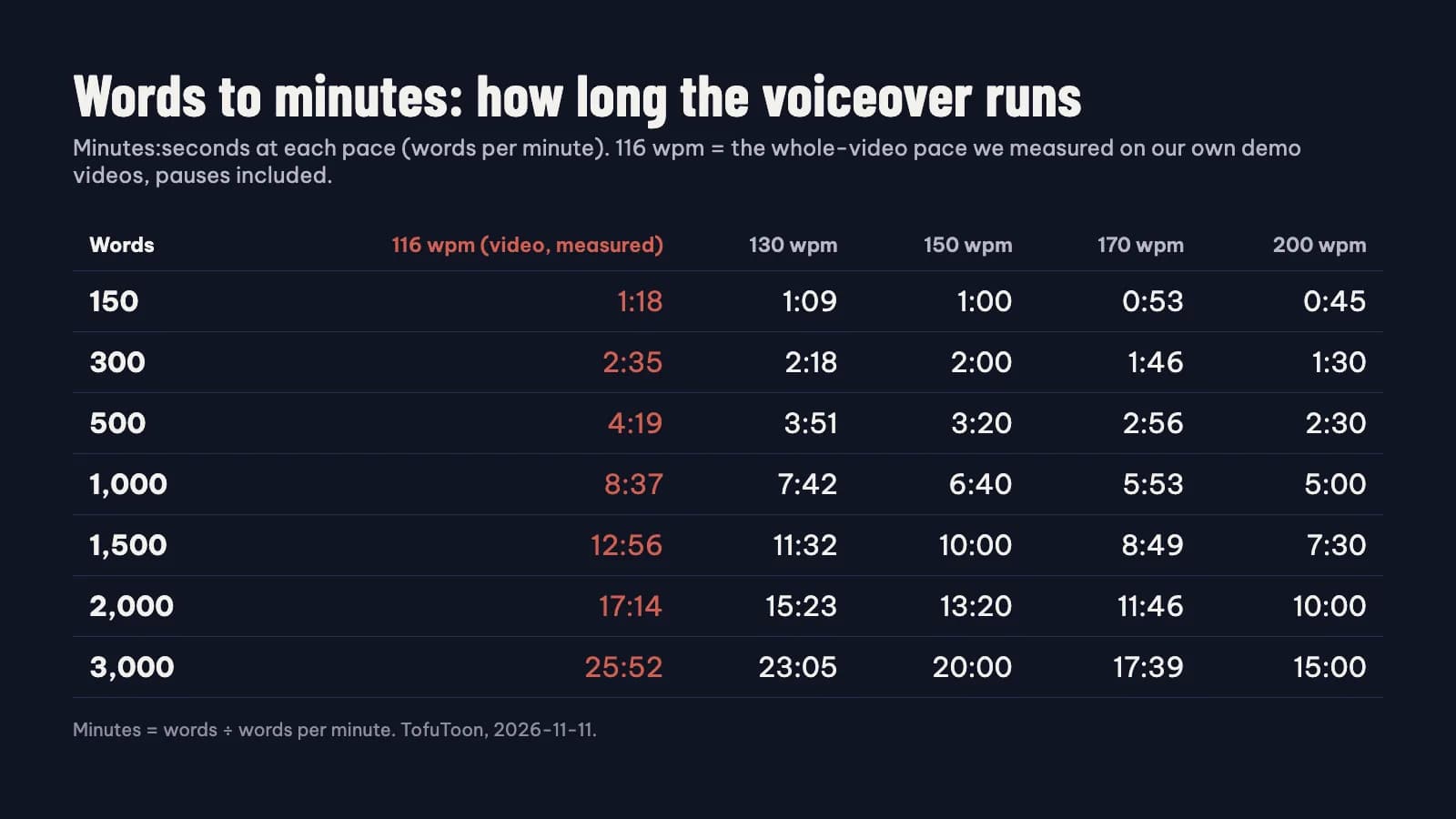
A 1,000-word script runs between 5 and 9 minutes, depending on the pace. The formula is minutes = words ÷ wpm, and the remainder times 60 gives the seconds. At 150 wpm, 1,000 ÷ 150 = 6.67 minutes, which is 6 minutes 40 seconds. At 130 wpm, a slow and clear narration, the same script takes 7:42; at 170 wpm, a brisk recap read, it takes 5:53. The table below runs the same sums for scripts from 150 to 3,000 words, plus one column for the pace we measured on whole videos, pauses included. Two things break the estimate. One is counting: numbers, names and hyphenated words are counted differently by different tools, so the same script can show a slightly different count in two editors. The other is anything that is not speech, such as a pause on a reveal panel or a music sting. The fix is to estimate with a range of paces, not one number.
What pace should a recap voiceover use?
For a recap or comic dub voiceover, plan with two paces: the speaking pace while the voice talks, and the whole-video pace, which includes the silences. We measured both on our own videos from their subtitle files. The English Tofu Image Text demo has 319 spoken words over 164.7 seconds. While the voice is talking it runs at 158 wpm, but across the whole video it comes to 116 wpm, because the voice stops while the screen shows a step. The Pro demo is more extreme: 320 words, 201 wpm while speaking, and again 116 wpm overall. Our 40-second ad, which has almost no pauses, measured 152 wpm speaking and 130 wpm overall. So the gap depends on how much your video shows without talking. A recap that holds on a splash page or lets a fight scene play needs the lower number. A dense narration over panning panels sits close to the speaking pace.
Why the TTS speed setting is not your real pace
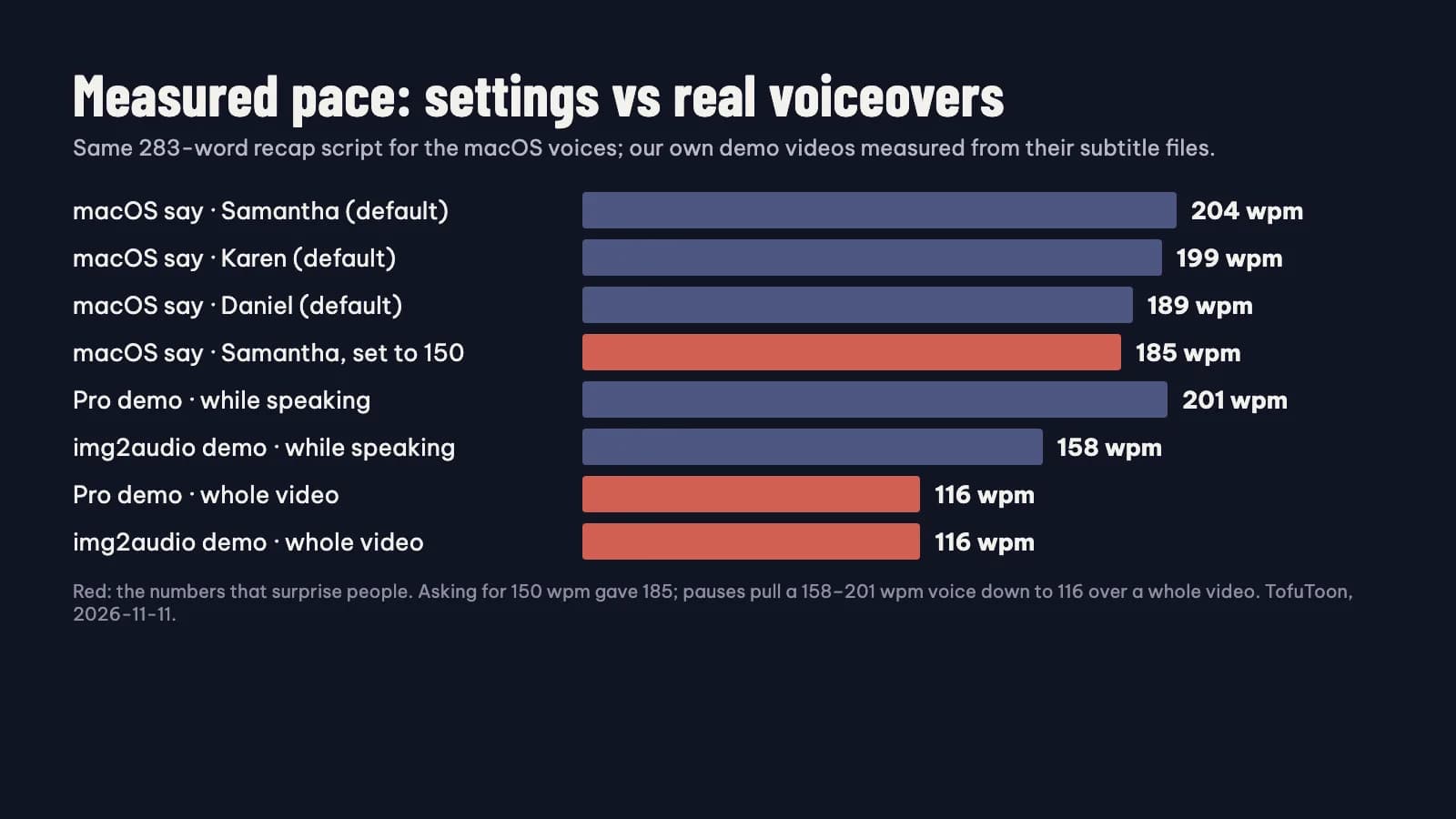
A text-to-speech speed setting is not a words-per-minute value: it changes the voice relative to its own default pace, so the real pace can be far from the number you typed. In our test with a built-in Mac voice, asking for 150 wpm gave 185. On a Mac, we read the same 283-word recap script with the built-in say command. At their default rate, the Samantha, Karen and Daniel voices ran at 204, 199 and 189 wpm. Asking Samantha for 150 wpm with the rate option produced 185 wpm; asking for 200 gave 229. Cloud voices work the same way. Microsoft's SSML reference describes the rate as a multiplier of the default, kept within 0.5 to 2 times the original: “+20%” means 1.2×, and the “fast” preset is 1.55× (Microsoft: SSML voice and prosody). So a voice that reads at 160 wpm will speak at about 192 at +20 %, and a voice that starts at 190 will speak at about 228. Time a 30-second sample of the exact voice and speed you will use, then enter that pace in the calculator.
How long can a YouTube Shorts script be?
A Shorts script for the 3-minute limit can be about 350 to 600 words, depending on the pace. YouTube’s help page says square or vertical videos up to three minutes long are classed as Shorts (YouTube Help: three-minute Shorts). Three minutes at 170 wpm is 510 words; at 200 wpm it is 600 words. At the 116 wpm whole-video pace we measured, it is only 348 words, so a script with pauses for reveal panels should stay well under 500. The same help page says most songs can be used for up to 90 seconds in a 3-minute Short, and some tracks only for 60 or 30 seconds, so a three-minute Short may need its music planned in parts. Most recap Shorts are much shorter than the limit anyway. A 45-second Short at 170 wpm is about 128 words, roughly one chapter's turning point told well. Writing to the word budget is faster than cutting audio later.
Reading time is not speaking time
Reading time and speaking time are different numbers, and mixing them up makes a script run long. Silent reading is faster than speech: a 2019 review of 190 studies by Marc Brysbaert estimated the average silent reading rate of English-speaking adults at 238 wpm for non-fiction and 260 wpm for fiction (Brysbaert, Journal of Memory and Language, 2019). That is why a script that feels short when you read it in your head runs long when it is voiced: 1,000 words takes about 4:12 to read at 238 wpm, but 6:40 to say at 150. "Reading time" labels on blogs use the silent rate, so do not use them for a voiceover. For a recap, also keep in mind what the reader of the comic did: they took in the art and the dialogue together. Your script has to cover both in spoken words, which is another reason scripts grow. Budget for the spoken pace, then cut lines that only restate what the panel on screen already shows.
How to measure your own words per minute
- Take 150 to 300 words of a real script, not a test sentence. Recap lines with names and numbers read slower than plain prose.
- Record it with the exact voice and speed setting you will publish with: your own voice, a TTS voice, or an AI voice.
- Read the length of the audio file in seconds. Any editor or player shows it; trim the silence at both ends first.
- Speaking pace = words ÷ seconds × 60. Our 283-word script at 83.3 seconds gave 204 wpm.
- For the whole-video pace, divide the words by the full length of a finished video of yours, pauses and all.
- Enter that number as the custom pace in the Words to Minutes calculator and plan the next scripts with it.
Where the estimate goes wrong
A word-count estimate is good for planning, not for cutting to the frame. Three things push the real length away from it. First, voices differ: on one script, our three Mac voices were 15 wpm apart at the same setting, which is about 23 seconds over a 1,000-word script. Second, punctuation changes timing: a TTS voice pauses at commas, full stops and paragraph breaks, so a script written as short punchy lines runs longer than the same words in long sentences. Third, editing adds time: music intros, title cards, a pause on a cliffhanger panel. Our two demo videos lost 27 and 42 percent of their speaking pace to pauses like these. The honest approach is to set a target length, write to the word budget at your measured pace, generate the audio, and then trim. If the comic pages are your starting point rather than a script, Tofu Image Text reads the speech bubbles, writes the recap script and voices it, so you can see the real length after one chapter instead of guessing.
FAQ
How many words is a 5-minute speech?
About 650 to 850 words at 130 to 170 words per minute, or 750 words at 150 wpm. If the video includes pauses for visuals, plan for fewer: at the 116 wpm we measured over whole videos, five minutes is about 580 words.
How long is 500 words spoken?
About 3:20 at 150 wpm, 2:56 at 170 wpm and 2:30 at 200 wpm. With pauses for visuals included, at 116 wpm, it is about 4:19.
What fits in a 60-second Short?
Between 130 and 200 words of voiceover, depending on the voice and speed. For a fast TTS voice, 180 to 200 words fits; for slow, clear narration, about 130.
Is the calculator free, and is my script uploaded?
The Words to Minutes calculator is free, needs no account, and counts the words in your browser. The text is not sent to a server.
Next step: write the script with our manhwa recap script prompt, choose a voice with the guide to AI voice-over for recap videos, and check the length in the free Words to Minutes calculator before you record.