
Manhwa recap script with AI: prompt template and examples
Raw speech bubbles do not make a script on their own. Here is a prompt template that turns chapter dialogue into third-person recap narration without invented plot.
A recap script is the narration a voice reads over the panels: chapter dialogue rewritten as a short third-person story. Raw speech bubbles are not a recap script, because bubbles skip who is speaking, where the scene is and what just happened. An AI model such as ChatGPT from OpenAI, Gemini from Google or Claude from Anthropic can do the rewrite in seconds, but only with clear rules. Without rules, a model changes character names, adds plot that is not on the page, and keeps sound effects that a voice then reads aloud. Length is easy to plan. For example, at a narration pace of 150 words per minute, a 1,200-word script gives an 8-minute video. The guide first shows why raw text fails, then gives a prompt template, a worked example and a name glossary. Finally, the guide covers YouTube rules for AI-written scripts.
Why is raw manhwa dialogue not a recap script?
Raw dialogue is the text exactly as the bubbles show it, in panel order, with no narration. A reader sees the art, so a bubble like "Run!" needs nothing else. A listener only hears the voice, so the same line gives no clue who shouts or why. For instance, take three panels: a status window, a shout and an explosion. OCR returns `"[Mana: 12] Run, Jin! KRAAK"`. Read aloud with CapCut or Microsoft Edge voices, the line becomes the word KRAAK and the number twelve with no context. The recap script for the same panels reads: `"Jin had twelve mana points left when Seo screamed at him to run, and the wall behind them gave way."` The script does three jobs: first, the script names the speakers; second, the script drops the sound effect; finally, the script keeps the facts. Clean panel order matters before any prompt; the steps are in extract text from manga pages.
What should a recap script prompt include?
The recap script prompt is a fixed set of instructions you reuse for every chapter, so episodes sound like one series. Five rules cover most problems. Write the rules once and reuse the rules with ChatGPT, Gemini or Claude. According to Google, the Gemini prompting strategies guide recommends including examples in prompts, so the template ends with one short sample of the style you want.
- Role and format: "Rewrite this chapter as third-person narration for a voice track. Plain sentences, no headings, no lists."
- Source only: "Use only events and lines in the text below. Do not add scenes, motives or outcomes that are not in the text."
- Glossary: "Spell these names exactly: Jin, Seo, Kael, the Black Gate." In practice, paste the same glossary for every chapter.
- Clean-up: "Remove sound effects such as KRAAK or WHAM. Turn status windows into one short sentence."
- Length and style: "About 800 words. Sentences under 20 words. Example style: Jin froze at the gate while Seo counted the guards."
How do you stop AI from changing names or inventing plot?
A name glossary is a short list of character names, places and skill names with the exact spelling for the whole series. A model may guess a spelling when OCR text has a typo, so `Kae1en` in one chapter can come back as Kaylen in the next. The glossary fixes the spelling at the source. Invented plot is the second risk. For instance, a model asked for "a dramatic recap" may add a betrayal that never happens in the chapter. The source-only rule in the template blocks most of that, and one check catches the rest. Read the script beside the 12 pages of a chapter, with Tofu Image Text or a printout, and mark any event you cannot point to on a panel. The same pass also catches wrong speakers. Keep the glossary in a Microsoft Word or plain text file next to the chapter folders, and add each new name the day the character first appears.
When is a chat window enough, and when does batch AI help?
A chat window is enough for one chapter. Paste the prompt and the chapter text into ChatGPT, Gemini or Claude, then save the answer. Say each chapter takes 10 minutes of pasting, waiting, copying and renaming. Then 30 chapters take 5 hours of handling, before any voice or edit.
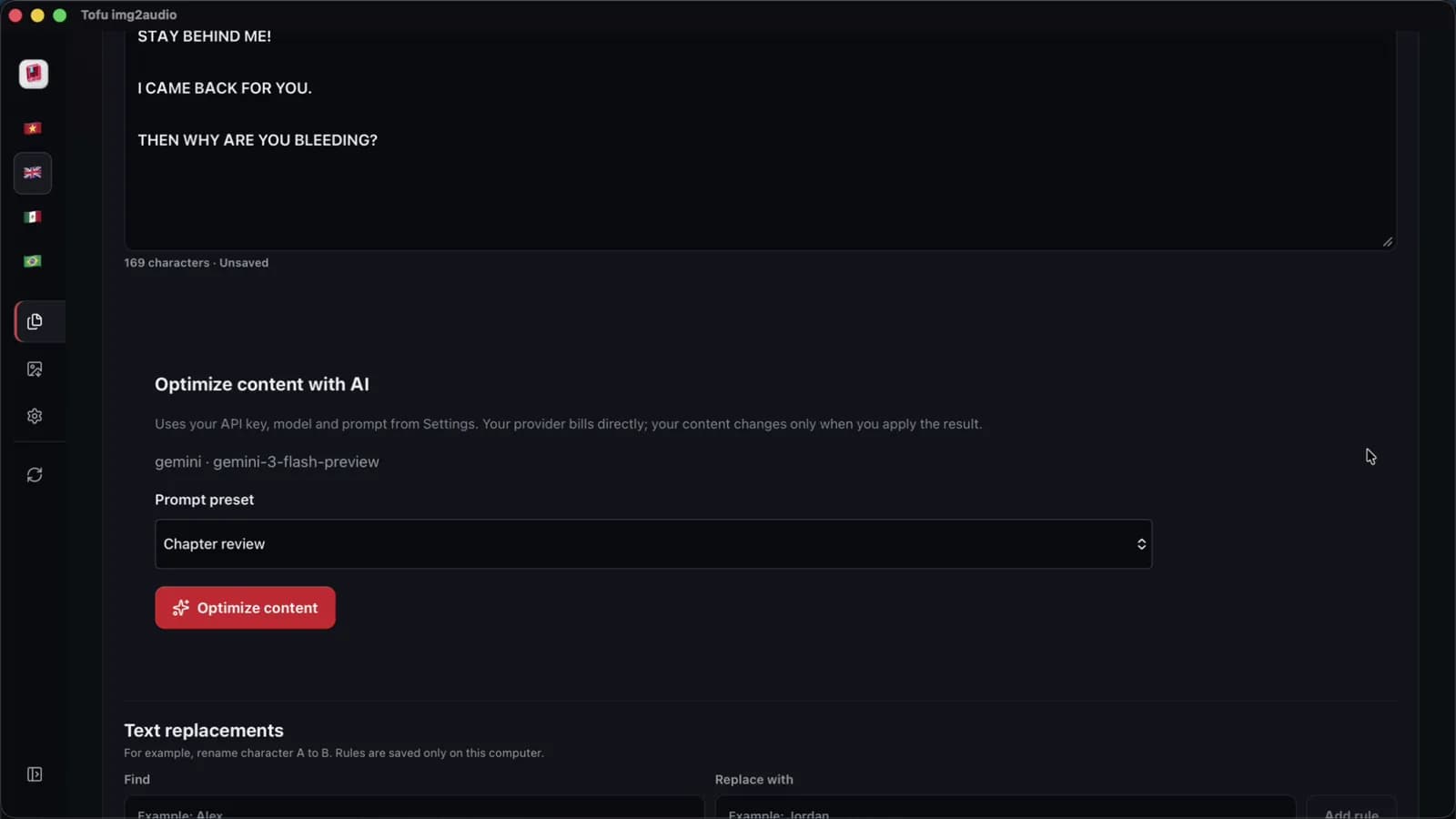
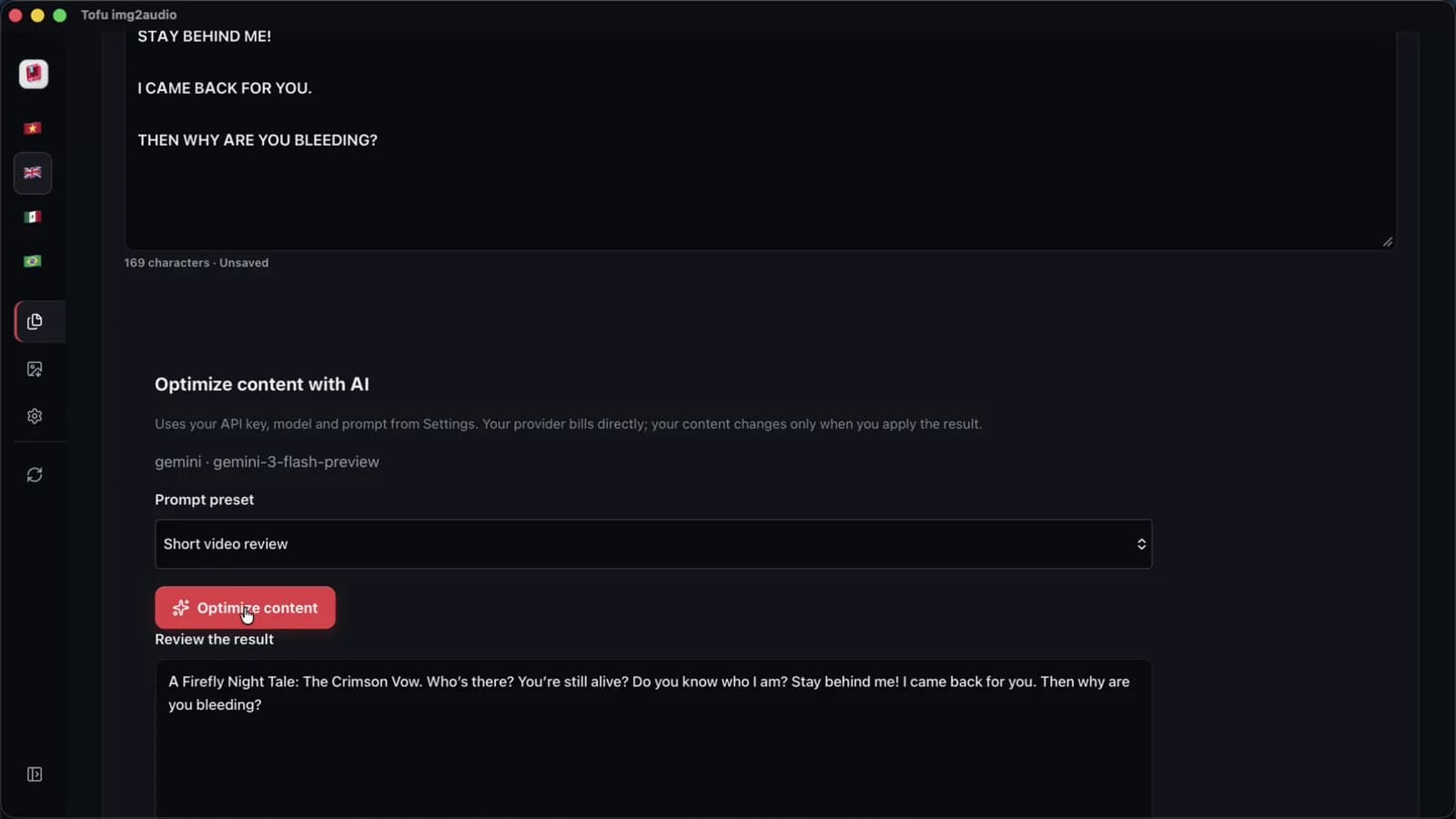
Tofu Image Text is a pay-once desktop app for Windows 10 or later and Apple silicon Macs (M1 or later). The app reads the pages with OCR on the computer, then rewrites each chapter with your own API key from OpenAI, Google, Anthropic, xAI or DeepSeek. Presets include Concise recap and Chapter review, and a custom prompt can hold the five rules above. The AI step sends the chapter text to the provider you choose, and the provider bills you directly. On an Apple M4 Pro, we measured the Gemini script step for one short chapter of 6 pages at about 6 seconds, in one recorded run; times depend on the model and the network.
What do YouTube rules mean for an AI-written recap script?
YouTube rules judge the video, not the tool that drafted the script. According to YouTube, on July 15, 2025, YouTube renamed the "repetitious content" policy to "inauthentic content" in the YouTube channel monetization policies, and the policy covers mass-produced or repetitive videos. A script only retelling the chapter, line by line, adds little of your own. A script with your view on the chapter adds more. In practice, end each recap with two or three sentences in your own words: what the chapter changed, which choice made sense, and what you expect next. The AI draft from ChatGPT or Gemini saves typing, and the commentary gives the video a reason to exist. Copyright on the panels and the story is a separate question; read recap videos and copyright before the first upload. This section is general information, not legal advice.
FAQ
Which AI model writes the best manhwa recap script?
No single AI model is best for every manhwa recap script. ChatGPT from OpenAI, Gemini from Google and Claude from Anthropic all follow a clear prompt well, and the prompt matters more than the brand. The fair way to choose is a side-by-side test with real chapter text. For example, the test takes two steps and one decision. First, run the same five-rule prompt and the same chapter of 12 pages through two models. Second, compare three things: name spelling, invented events and sentence length. Finally, keep the model that breaks the fewest rules, and save both outputs for later reference. Price matters too, since OpenAI, Google and Anthropic each bill API use differently, and a long series multiplies the cost of every chapter. Once a model is chosen, keep the model and the prompt fixed for the whole series, so every episode sounds the same.
How long should a recap script be for a 10-minute video?
The recap script for a 10-minute video is about 1,500 words at a narration pace of 150 words per minute. The math is 10 × 150 = 1,500. A chapter script of 750 to 900 words gives 5 to 6 minutes, so a 10-minute video covers about two chapters at that length. Voices read at different speeds. Say a fast CapCut voice may finish the same script sooner than a calm Microsoft Edge voice. Time the first episode with the chosen voice, then set the word target in the prompt for the next chapters. Ask the model for a word count, then check the count yourself, because a model can miss the target. For instance, a short note with the word target and the voice name keeps every chapter in the same length range.
Can AI write the commentary part of a recap script too?
AI can draft commentary, but model commentary is generic. Commentary is the part of a recap script that should be yours. Since July 15, 2025, the YouTube channel monetization policies focus on whether a video is mass-produced or repetitive. A model-written opinion repeats easily across channels. In practice, let the model write the retelling first. Then add your own view at the end of each episode: which choice surprised you, how the chapter compares with an earlier arc, or what you expect next. Read the commentary aloud using your CapCut or Microsoft Edge voice, and cut anything you would not say.
Next step: write the five rules into one prompt, build a name glossary for your series, and run one chapter through two AI models. Compare the scripts beside the pages and keep the better setup. To run OCR, the AI script and the voice in one app, see Tofu Image Text, and for the voice step read AI voice over for recap videos.