
Start an anime recap channel in 2026: niche, series, workflow
Starting an anime recap channel takes an afternoon. Keeping a weekly schedule for a year is the hard part. Here is a setup built for consistency.
An anime recap channel is a YouTube channel that summarizes the story of anime episodes or manga chapters with narration over images, plus the creator’s own commentary. Starting one is easy: a channel, a voice and an editor are enough. Keeping a schedule is the hard part, because every episode repeats the same work of reading, scripting, voicing and editing. For example, the YouTube Partner Program from Google asks for 1,000 subscribers and 4,000 qualified watch hours in the last 12 months, and reaching the bar takes many uploads. The guide first covers the niche and the series, then a schedule you can keep. Finally, the guide lays out a chapter-to-upload workflow and the mistakes behind stalled channels. Anime recaps and manga recaps share the same setup; the differences are in the copyright section and the FAQ.
Which niche should an anime recap channel pick?
A niche is the one kind of story the channel covers, so a viewer knows what the next video will be. A channel that recaps anything gives a viewer no reason to expect the next video: a fan of a romance recap gets a dungeon recap next. Pick one lane and stay in the lane for the first 30 uploads. Common lanes are action and dungeon manhwa, isekai and fantasy manga, romance webtoons, and seasonal anime. For instance, a channel called "system manhwa recaps" tells a viewer more than "anime and manga recaps". Check the lane before committing: search YouTube for the series names in the lane, look at how recent the top recap videos are, and compare the series names in Google Trends. A lane where the newest recaps date from 2023 or earlier may have little demand left. A lane with many fresh recaps has demand and competition, so the commentary has to stand out.
Which series can carry a recap channel for months?
The right series is a story with enough chapters to fill months of uploads and a fan base still talking about the story, which Google Trends can confirm. Long series help because one series can carry a playlist. For instance, a manhwa with 120 chapters at 3 chapters per video gives 40 videos, close to a year at one upload a week. Ongoing series also bring new chapters to recap. Check three things before picking. First, the length: count the chapters and divide by the chapters per video. Second, the rights: check whether the publisher states a policy on fan videos, and skip series where the publisher says no. Third, the source: use a legal reading platform such as Webtoon from Naver, Tapas or an official publisher app, and link that platform in each description. The rules are covered in recap videos and copyright.
How many anime recap videos a week can one person keep up?
The right pace is a schedule you can keep for a year, not an ambitious one you drop after a month. Work out the hours per video first, then pick the upload count. Say one recap covers three chapters of 50 pages, and each chapter takes about an hour from reading to a finished voice track. Then the prep alone fills three hours per video, before any editing. At that pace, two uploads a week cost a full working day of prep plus the edits. YouTube Studio from Google shows the real watch time of each upload, so the effort can be compared with the results. Most of the prep is retyping and file handling, which a batch tool can shorten, while the commentary still needs your time. In practice, start with one upload a week for the first month, measure your real hours per video, and only then add a second upload. A steady schedule also lets subscribers learn when to expect the next episode.
What does a chapter-to-upload workflow look like?
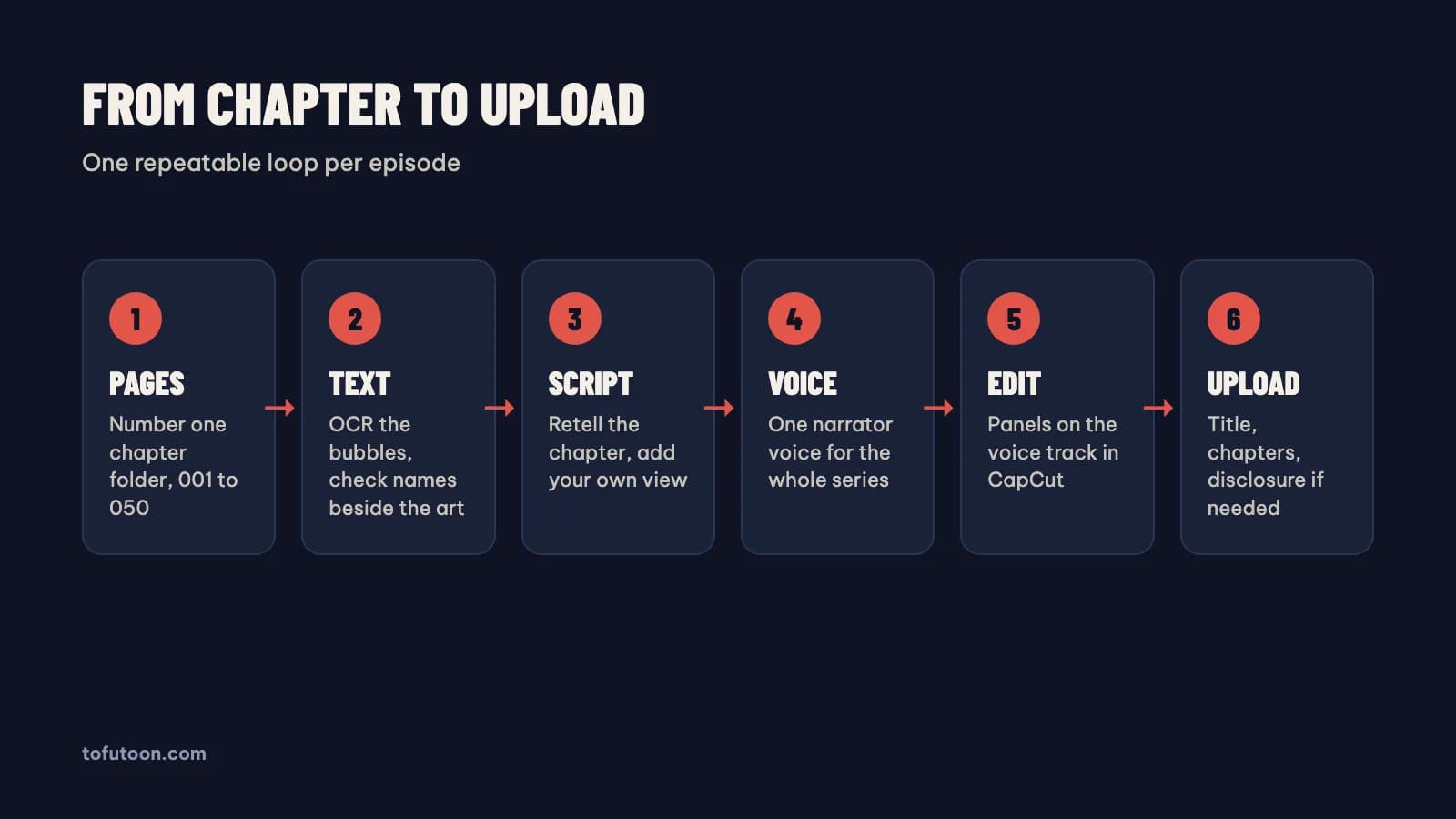
A chapter-to-upload workflow is a fixed order of steps turning a chapter folder into a published video, the same way every time. Six steps cover the whole job, and the order matters, because each step feeds the next one. For example, a chapter of 50 pages goes through all six steps before the upload:
- Pages: put one chapter in one folder and number the pages from 001 to 050, so every tool reads the pages in order.
- Text: extract the speech bubbles with OCR and check names beside the art, using a fixed name glossary.
- Script: retell the chapter in third person and add your own commentary.
- Voice: read the script with one narrator voice for the whole series.
- Edit: put the voice track on the timeline using CapCut, then stretch each panel to its lines.
- Upload: title, chapters, description credits, an official reading link and any disclosure YouTube asks for.
Where does a desktop app fit in an anime recap workflow?
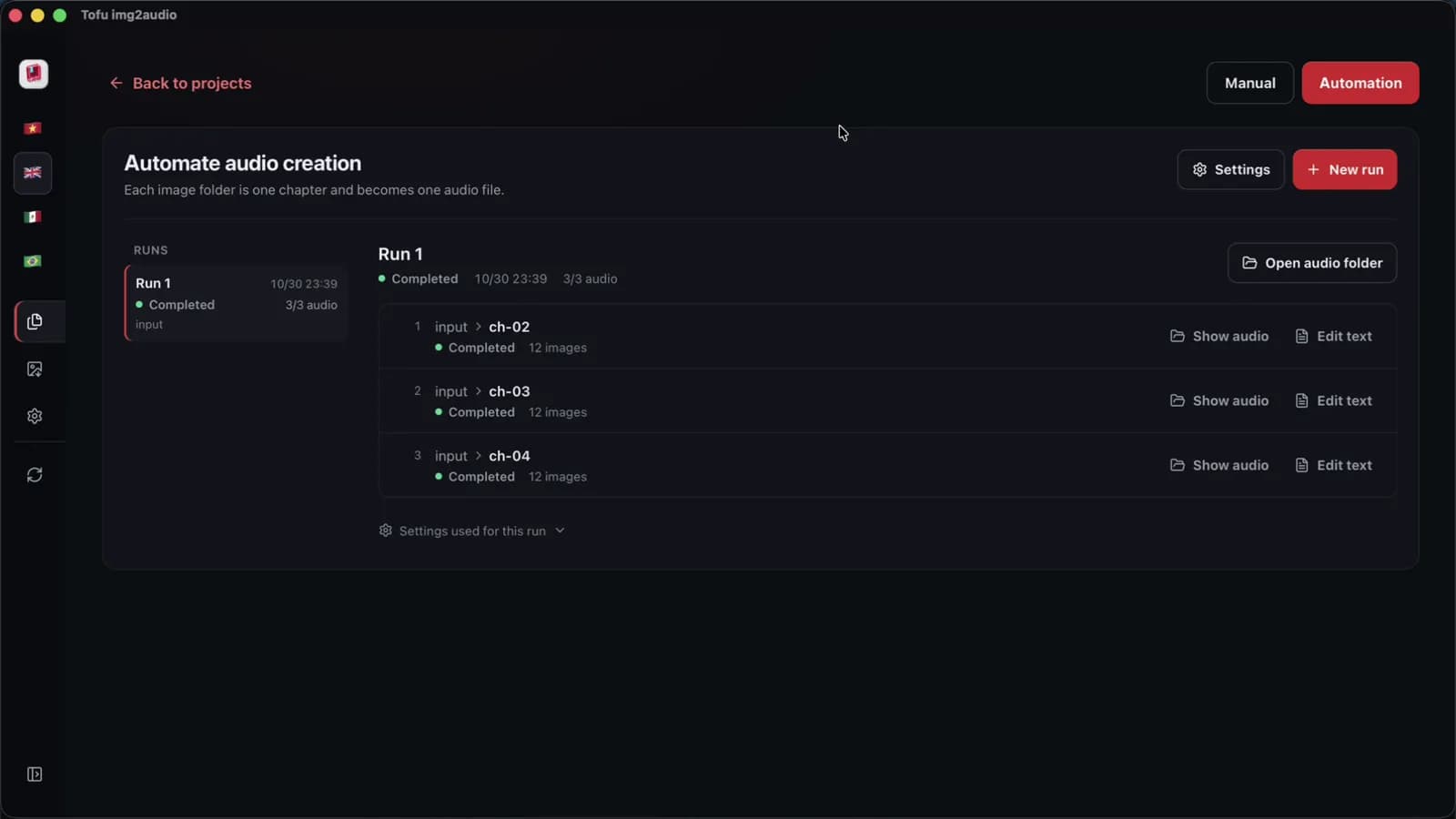
A desktop app fits the middle of the workflow: text, script and voice, where most of the handling is. Steps 2 to 4 repeat for every chapter, so the work grows with every series. Tofu Image Text is a pay-once desktop app for Windows 10 or later and Apple silicon Macs (M1 or later). The app runs OCR on the computer, rewrites the dialogue with your own AI key, and saves one audio file per chapter. On an Apple M4 Pro, we measured the automation queue at 2 minutes 40 seconds for three 12-page chapters, in one recorded run with short sample pages. Edge voices from Microsoft and CapCut voices send the script text to that voice service, and the AI step sends text to your AI provider. The app does not edit video, so Step 5 stays in CapCut. Details of each step are in how to make manhwa recap videos.
Which mistakes stall a new anime recap channel?
Five mistakes stall new channels, and each one is easy to fix early. The first mistake is changing the narrator voice between episodes, which makes a series sound like a different channel. The second is reading the dialogue aloud with no commentary, which adds little original value, the issue behind the "inauthentic content" policy YouTube renamed on July 15, 2025. The third is switching niche every week, so no viewer knows what comes next. The fourth is skipping the description: no credit, no official link and no chapters. Finally, promising daily uploads and stopping after a month breaks the routine. In practice, one recap a week for six months gives 26 videos and a routine, while daily posts for two weeks and then silence give 14 videos and no routine. Pick the pace that survives a busy week.
FAQ
Does an anime recap channel need a face on camera?
An anime recap channel does not need a face on camera. The edited panels or clips carry the picture, and a narrator voice carries the story. YouTube asks for original value in a monetized channel, and a presenter on camera is not required for original value. Original value comes from your own summary, analysis and editing choices. For instance, a recap can first summarize the chapter, then end with a short segment on what the chapter changed and what may come next, read by the same narrator voice used in every episode. The voice can be your own recording or an AI voice from Microsoft Edge, CapCut or ElevenLabs. Keep the same voice for the whole series, since a new narrator sounds like a new channel. Faceless formats are covered in more depth in [faceless YouTube channel with comic recaps](/blog/faceless-youtube-channel-comic-recaps).
How long does it take an anime recap channel to grow?
No honest guide can promise a growth timeline for an anime recap channel, because growth depends on the niche, the series, the quality and luck. What can be measured is the bar for monetization. Eligibility, according to YouTube, needs 1,000 subscribers plus either 4,000 qualified watch hours in the last 12 months or 10 million qualified Shorts views in the last 90 days. In practice, a creator can track subscribers and watch hours in YouTube Studio from Google every month and compare the trend with the bar. If the numbers stay flat after 30 uploads, change one thing at a time: the series, the thumbnails, or the commentary. Treat the first months as practice in a repeatable workflow, and keep a simple log of hours per video next to the views of each upload.
Should a new channel make anime recaps or manga recaps?
In our view, a new channel takes less risk starting with manga or manhwa recaps than anime recaps. Anime clips are video and audio, the kind of material YouTube matches using Content ID, so anime recaps can meet more automated claims. Manga panels are still protected works. Anime recaps have one advantage: search demand. In Google Keyword Planner data we pulled for the US in October 2026, "anime recap" had about 4,400 monthly searches against about 880 for "manga recap". For example, a channel can start with a manhwa that has an anime adaptation and recap the source chapters. Credit the source and link the official release.
Next step: pick one lane and one series with at least 60 chapters, then make the first three recaps before announcing a schedule. Time each step and set the weekly pace from real hours. To cut the retyping and audio steps, see Tofu Image Text, and read AI voice over for recap videos before choosing the narrator.