
Faceless YouTube channel with comic recaps: a real plan
Comic recaps are one of the few faceless formats where the picture already exists. Here is a plan that stays inside YouTube rules and survives a busy week.
A faceless YouTube channel is a channel where the creator never appears on camera, and the video carries the story with images, text and a voice. Comic recaps fit the faceless format well, because the panels already give the viewer something to watch. The creator adds a script, a narrator voice and edits, plus the part YouTube cares about most: original commentary. For instance, in Google Keyword Planner data we pulled for the US in October 2026, "faceless youtube channel" had about 2,400 monthly searches, so the idea draws real interest. Most guides sell the dream; the plan below covers the work instead. First, why comic recaps suit a faceless channel. Second, the weekly production loop and the costs. Finally, the YouTube rules on monetization, copyright and AI disclosure, plus the common myths about faceless channels.
Why do comic recaps work for a faceless YouTube channel?
A comic recap is a strong faceless format, because every chapter comes with finished art in reading order. Other faceless formats need stock footage, screen recordings or generated images for every sentence. A recap needs the panels of the chapter, cropped and timed to the voice. The story structure also exists already: a chapter has a setup, a turn and a cliffhanger, and the script follows that shape. In practice, a manhwa chapter of 50 pages can become a 5-minute narrated segment without a single new image. The format has two limits. First, the art belongs to someone else, so copyright matters on every upload. Second, the retelling alone is easy for anyone to copy, so the commentary is what makes one channel different from another. Both limits are covered below, with links to the official YouTube pages from Google.
What does a weekly faceless production loop look like?
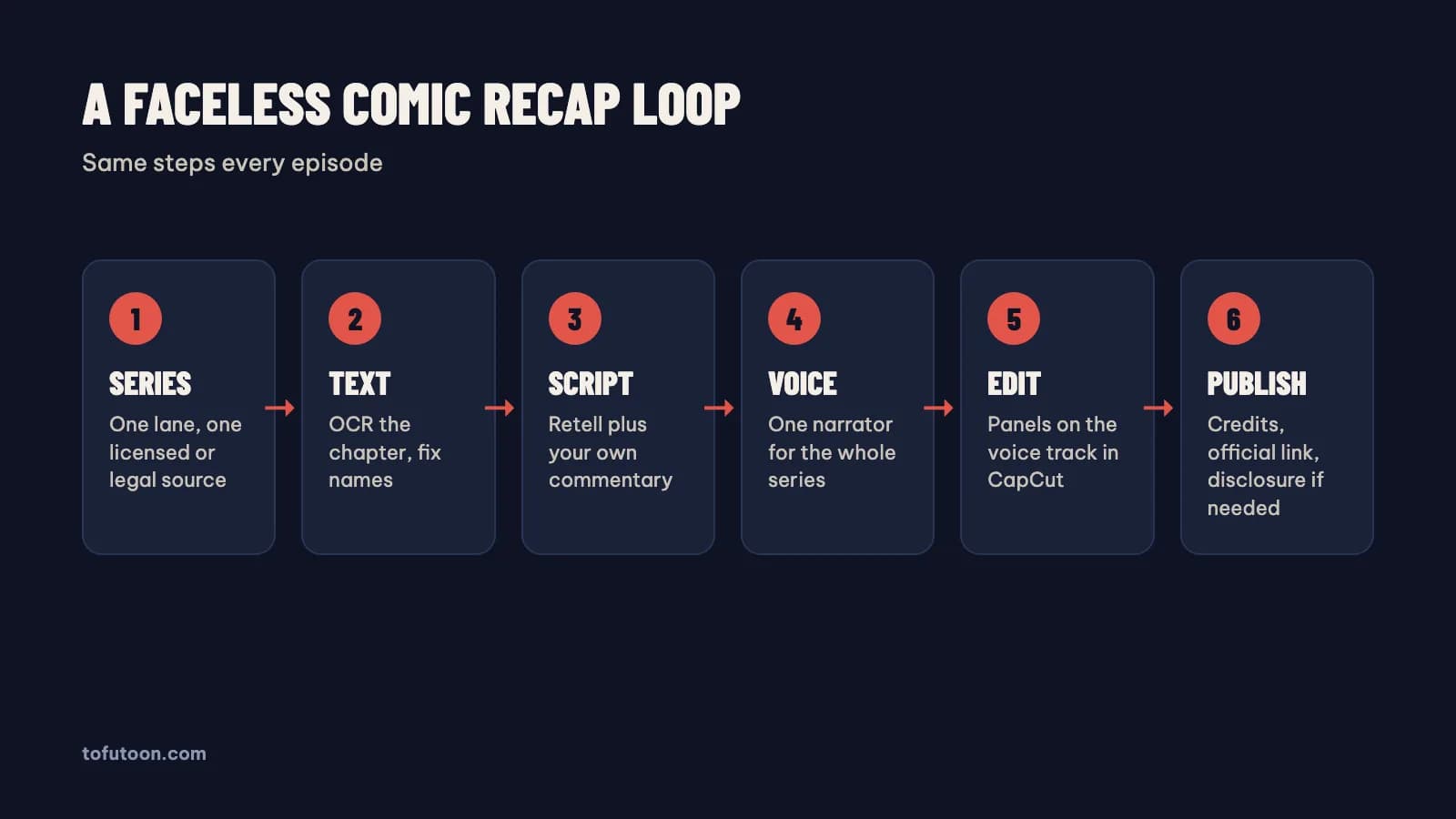
A production loop is the fixed set of steps every episode goes through, so the channel runs on routine instead of motivation. Six steps cover a comic recap episode, for example one chapter of 50 pages:
- Series: one lane and one series, read on a legal platform such as Webtoon or an official publisher app.
- Text: extract the speech bubbles with OCR and fix names against a glossary.
- Script: retell the chapter in third person, then add your own view of the chapter.
- Voice: one narrator voice for the whole series, from Microsoft Edge, CapCut or ElevenLabs.
- Edit: put the voice track on the timeline using CapCut and time each panel to its line.
- Publish: credits, an official reading link and any disclosure YouTube asks for.
Plan one upload a week for the first month, and only add a second upload when the loop feels easy. The details of each step are in how to make manhwa recap videos.
Which voice should a faceless comic recap channel use?
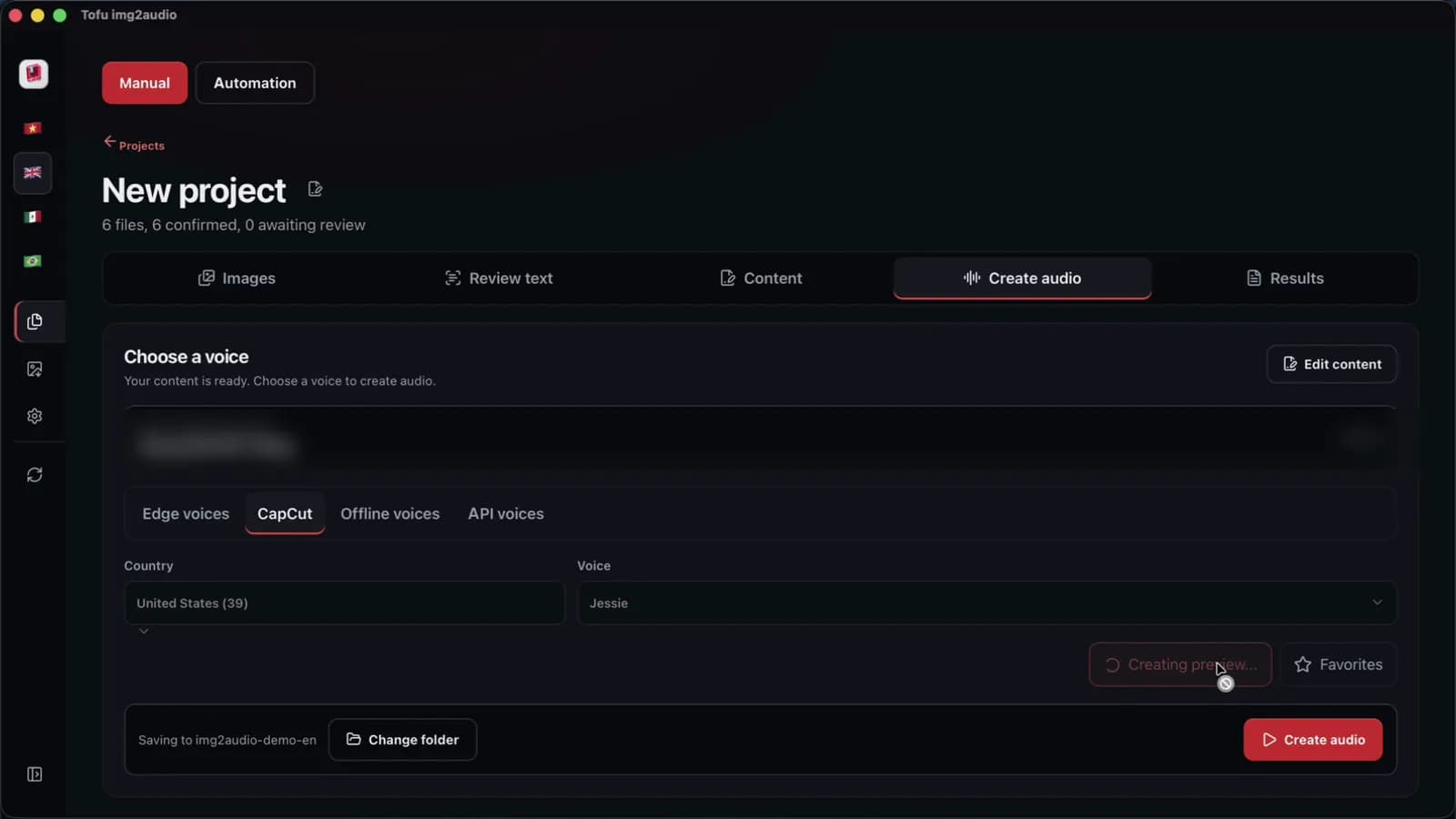
The narrator voice is the face of a faceless channel, so the voice has to stay the same for the whole series. Options are your own recorded voice, free AI voices or paid AI voices. Microsoft Edge neural voices sound calm over long chapters. CapCut voices are brighter, and Tofu Image Text lists 129 CapCut voices in the app (counted on 2026-10-31). ElevenLabs voices are the most expressive and connect through the ElevenLabs API, with ElevenLabs billing the usage. For instance, first test each candidate voice on one line with names, numbers and a question, then keep the clearest one. Your own voice is the most personal choice, but your own voice also takes the most time per episode. AI voices for a narrator are fine on YouTube. Only realistic voices of real people need extra care under the disclosure rules. The full voice test is in AI voice over for recap videos.
How does a faceless YouTube channel stay monetizable?
Staying monetizable means meeting the same rules as any channel, and a face on camera is not one of the rules. First, the eligibility bar. The Partner Program needs 1,000 subscribers plus 4,000 qualified watch hours in 12 months, according to YouTube. The other route is 10 million qualified Shorts views in 90 days, as the YouTube Partner Program page lists. Second, original value: on July 15, 2025, YouTube renamed the "repetitious content" policy to "inauthentic content" in the channel monetization policies, which covers mass-produced or repetitive videos. Finally, disclosure: realistic synthetic content, such as a cloned voice of a real person, needs a label under the GenAI disclosure rules. For example, a recap with a clearly synthetic narrator and your own commentary is a different case from a voice copying a real person. Copyright is a separate check, covered in recap videos and copyright.
What does a faceless comic recap channel cost to run?
Running costs for comic recaps are mostly time, plus a few optional tools. CapCut desktop has a free plan for the edit, and Microsoft Edge and CapCut voices cost nothing to try. Paid items are AI script usage, which your provider, such as Gemini from Google, bills per token, and ElevenLabs usage, which ElevenLabs bills directly. Tofu Image Text is a pay-once desktop app for Windows 10 or later and Apple silicon Macs (M1 or later). The app reads the bubbles with OCR on the computer, rewrites the dialogue with your own AI key, and saves one audio file per chapter. Edge and CapCut voices send the script text to that voice service. On an Apple M4 Pro, we measured the automation queue at 2 minutes 40 seconds for three 12-page chapters, in one recorded run with short sample pages. A full budget formula is in recap channel costs.
Which faceless channel myths should you ignore?
Faceless channel content online is full of promises, and three myths cause the most wasted months. The first myth is "fully automated income". A channel still needs choices: which series, which panels, what you think about the chapter. Automation removes typing, not judgment. The second myth is "AI voices get channels banned". The policy pages from Google focus on repetitive, mass-produced content and on realistic synthetic people, not on the use of an AI narrator. The third myth is "post daily or die". A schedule you keep for a year beats a daily burst that stops after two weeks. In practice, one recap a week for six months gives 26 videos and a routine. No honest guide can promise views, subscribers or income from a faceless channel, and this guide does not either. Treat the first months as practice: measure hours per video in a simple log, and improve one thing at a time.
FAQ
Is a faceless YouTube channel allowed to monetize?
Yes. Faceless channels may apply for monetization like any other channel. The YouTube Partner Program asks for 1,000 subscribers plus watch hours or Shorts views, and no rule asks for a face on camera. What YouTube reviews is the content: original value, no mass-produced repetition, copyright, and disclosure of realistic synthetic content. For example, a comic recap channel with a steady narrator voice, edited panels and real commentary in every episode meets the original-value test far better than a channel reading dialogue word for word. The channel monetization policies from Google list the rules in full, and the July 15, 2025 rename to "inauthentic content" is worth reading before the first monetization application. Plan the commentary from Episode 1, not after a rejection, and keep the commentary in your own words every single time.
How many videos a week should a faceless recap channel post?
The right number of videos is the number the creator can keep for a full year, and for a solo creator, one a week is a safe start. A recap episode needs reading, a script, a voice track and an edit, and each step takes real hours. For example, say each chapter takes about an hour from reading to a finished voice track, and one episode covers three chapters of 50 pages. Then the prep alone takes three hours per video, before editing in CapCut. Start with one upload a week for a month, log the real hours, and only then decide on a second upload. YouTube Studio from Google shows the watch time per video, so the effort can be compared with the results. Adjust the pace every month, not every single week.
Do I need my own voice for a faceless recap channel?
Your own voice is optional. An AI narrator is a good fit too: voices from Microsoft Edge, CapCut or ElevenLabs work, as long as the same voice reads every episode of a series. Your own voice adds personality but takes more time per episode. AI voices suit a tight schedule, and your own voice suits a personality-led channel. If unsure, first record one test episode. In practice, one option is to record only the commentary section in your own voice and let an AI voice read the retelling. Under the YouTube GenAI disclosure rules, a clearly synthetic narrator differs from a cloned voice of a real person. Never clone anyone without permission.
Next step: pick one lane and one series, run the six-step loop on one chapter, and log the hours. Then decide on a weekly pace from real numbers. To cut the retyping and audio steps, see Tofu Image Text, and read how to start an anime recap channel for the niche and series choice.