
Faceless YouTube niches that can keep monetization
Niche lists rank by CPM figures nobody can check. We looked at what YouTube reviewers say they look at, and sorted faceless topics by what you would have to add.
The best faceless YouTube niches are the ones where you have something to add that a template can't. That sounds soft, so here's the hard version. Plenty of lists rank faceless niches by CPM, with figures that may or may not apply to your channel, your country or this year. We won't quote any, because we can't check them. What we can read is YouTube's own policy on what gets a channel removed from monetization, and for a faceless channel that's the risk worth planning around.
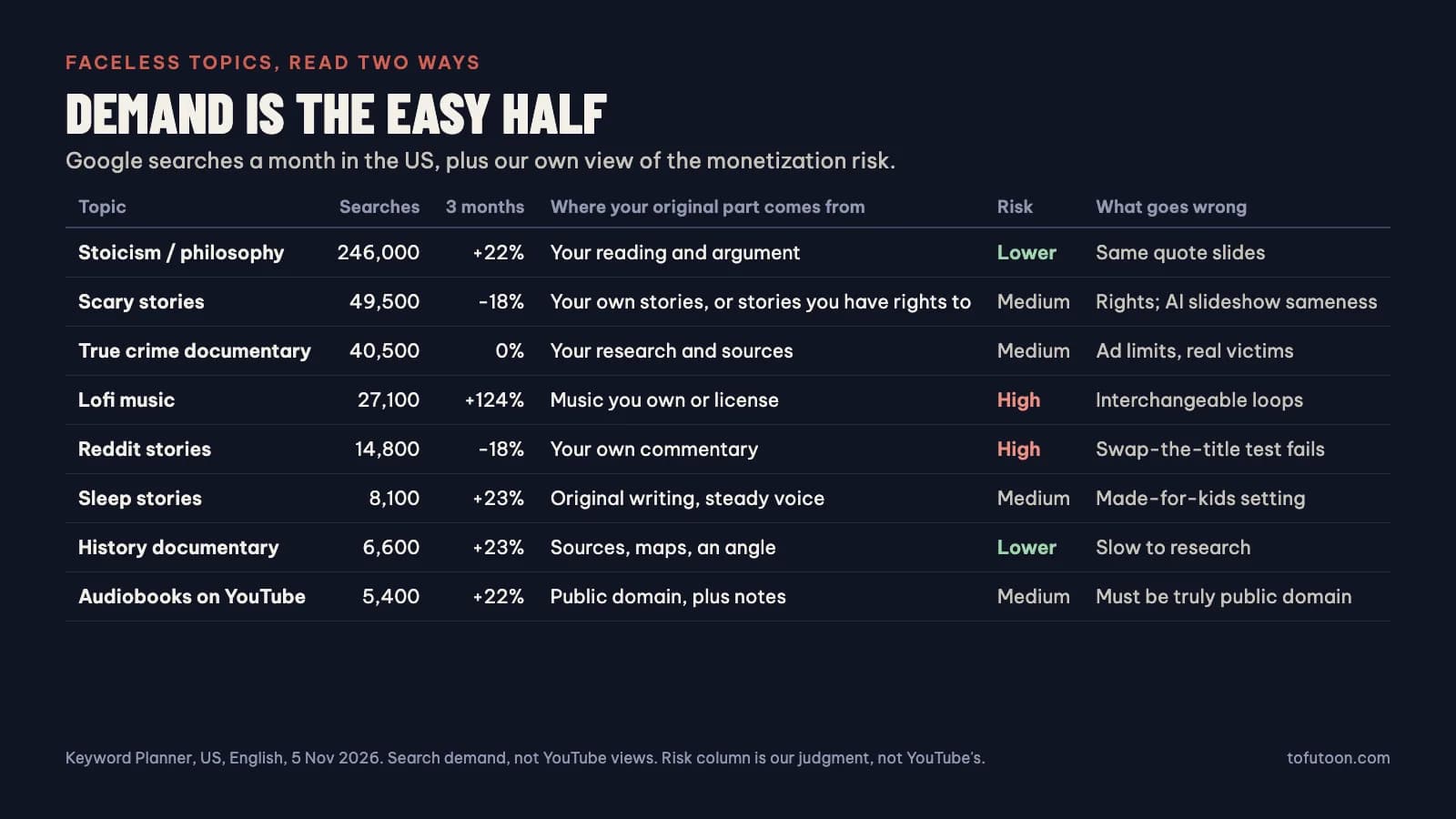
We've sorted eight topics by demand, using Google search data, and then by how hard it is to make them your own. No list can promise you income, and this one doesn't try.
What YouTube says its reviewers check
The channel monetization policies ask for two things: your content should be your original creation, so borrowed material needs changing significantly, and it shouldn't be mass-produced, generic, repetitive or manipulative. Reviewers can't watch everything, so the page lists where they may focus: your main theme, your most viewed videos, your newest videos, whatever earns the most watch time, your titles, thumbnails and descriptions, and your About section.
That list matters for picking a niche. You can't hide a template factory behind three good videos, because reviewers look at the channel's shape. So ask a different question of any niche: once you've followed the formula, what's left that only you could have made? If the answer is nothing, a higher CPM won't help you.
How to read the demand numbers
These come from Google Keyword Planner for the US in English, pulled on 5 November 2026. They count Google searches, not YouTube searches or views, so they tell you people care about a topic. They won't tell you a channel will get watched. Stoicism gets 246,000 searches a month, and "stoicism meaning" alone gets 40,500, so plenty of those people just want a definition. Don't treat that as 246,000 potential subscribers.
Trends need caution as well. Lofi music shows +124% over three months and -18% over the year, which looks more like a bounce than growth. We look at the last three months and sanity-check against the year. Reddit stories and scary stories are both down 18% on three months. True crime documentary is flat. History documentary and sleep stories are up 23%, and audiobooks on YouTube are up 22% on both windows, the only topic here growing on both counts.
Eight niches, and what you would have to add
Stoicism and philosophy (246,000 searches, up 22%)
The sources are old and free to quote, so you're starting with a lot of freedom. The bad version is quote slides over stock footage, and there's no shortage of it. The good version argues with the text: take one passage from Epictetus and apply it to something that happened to you last week. We rate the risk as lower because your thinking is the product, and that's very hard to template.
History documentary (6,600 searches, up 23%)
Our other lower-risk pick, and the slowest to make. Your original part is the angle, the sources you read and the maps you draw. One well-researched video on a forgotten local event is hard for a content mill to copy. Watch your visuals, since archive photos and film clips come with their own rights, and budget real research time per video.
True crime documentary (40,500 searches, flat)
Good demand, with two complications. Real victims and real families are involved, so treat them that way. And the advertiser-friendly guidelines limit ads on content focused on violence or tragic events, so even a compliant video may earn little. Your original part is primary-source work: court records, timelines you built yourself. A rewritten Wikipedia page is what everyone else is making.
Scary stories (49,500 searches, down 18%)
Write your own. It's the simplest way out of both problems here: rights and sameness. A channel of original horror fiction with one steady voice is yours completely, with no one else's rights in the text. The risk rises fast if you use other people's stories or generate interchangeable scripts with a slideshow, so we rate this one medium.
Sleep stories (8,100 searches, up 23%)
Calm original writing and a voice people can fall asleep to, which also makes it a topic where AI narration can fit well. One thing to get right from day one: if a story is aimed at children, YouTube requires you to set it as made for kids, and that setting affects features on the video. "Bedtime stories for adults" is a different audience with its own searches, about 14,800 a month. Pick one and say so clearly.
Audiobooks on YouTube (5,400 searches, up 22%)
Public domain books are free raw material, and that's the trap: anyone can upload the same text. Add something. A short introduction, notes on an old word, or a discussion after each chapter makes it yours. Check the status for your country, and read Project Gutenberg's license if that's your source. For scale, the first chapter of Pride and Prejudice is 859 words, which ran about 4 minutes 51 seconds in Aria's voice with edge-tts 7.3.1. The whole novel works out to about 12 hours, so it could be a long series.
Reddit stories (14,800 searches, down 18%)
We'd stay away. Reading posts over gameplay footage is one of the easiest formats on this list to mass-produce, and it's close to what the policy describes. The posts aren't yours either: Reddit's User Agreement says users keep ownership rights in their content. If you love the format, write your own stories in that style, or make your commentary the point of the video. Then it's a different format.
Lofi music (27,100 searches, up 124%, down 18% on the year)
A strange fit for a faceless list, and a high risk in our view unless you make or properly license the music. Hours of near-identical loops are what "repetitive" looks like to someone scanning a channel. If you're a musician, this is a legitimate way to publish. If you're planning to generate tracks in bulk, read the policy again first, because that plan sounds a lot like what it describes.
Where comic recaps fit
This is the niche our own tool serves, so weigh what we say accordingly. Comic recaps give you art and a story structure, and they let your commentary do the original work. They also carry the largest rights problem in this post, because the art belongs to someone else on every upload. Publishers do enforce, and we won't call any recap copyright-safe. If you want to go there, read a faceless channel with comic recaps and recap videos and copyright. Comics you've drawn or licensed remove that problem.
A test that takes ten minutes: swap the title
We put every faceless idea through one test. Write three video ideas for the channel, then imagine swapping the titles and thumbnails between them. If the videos would still more or less fit, they're interchangeable, and that's the word to worry about. The policy doesn't object to a format as such. YouTube's examples of what's fine even include a repeated intro and outro, and recurring characters, as long as each video has its own substance and story. A repeated shape is fine. Repeated substance is where you get into trouble.
Then be honest about the trade-off. The lower-risk niches here are slower: research, drafts, your own thinking. Fast formats are fast for everyone, so that's where the competition piles up and where review risk sits. We don't know a way to get both, and any course telling you otherwise is selling you something. Our guide to faceless YouTube automation goes through what's safe to hand off.
FAQ
What is the most profitable faceless YouTube niche?
We don't know, and we doubt anyone can tell you for your channel. Pay varies by audience, country, season and video. Pick a niche you can make 50 videos in without running out of things to say, then read your own numbers once you have them.
Can a faceless channel use an AI voice and stay monetized?
An AI voice isn't what the policy targets. It targets mass-produced and interchangeable content, and a voice can be part of either a good channel or a bad one. Realistic impersonation of real people is a separate issue with its own disclosure rules.
How many videos do I need before applying for monetization?
There's no video count. The [Partner Program](https://support.google.com/youtube/answer/72851?hl=en) asks for 1,000 subscribers plus 4,000 qualified watch hours in 12 months, or 1,000 subscribers and 10 million Shorts views in 90 days.
Choose two topics from this list and write ten video titles for each, the kind only you could make. Whichever one you can finish is your niche. When it's time to produce, Tofu Voice turns scripts into MP3 narration, and Tofu Image Text handles scanned or comic pages. Neither one will supply the original part, so start with the titles. If you'd rather see ideas sorted by what you already have, try faceless channel ideas.