
Novel Outline Template: Premise, Acts and Scenes
Outlining works in layers: premise, the big turns, then scenes. A template for each layer, and how to keep it useful while you draft.
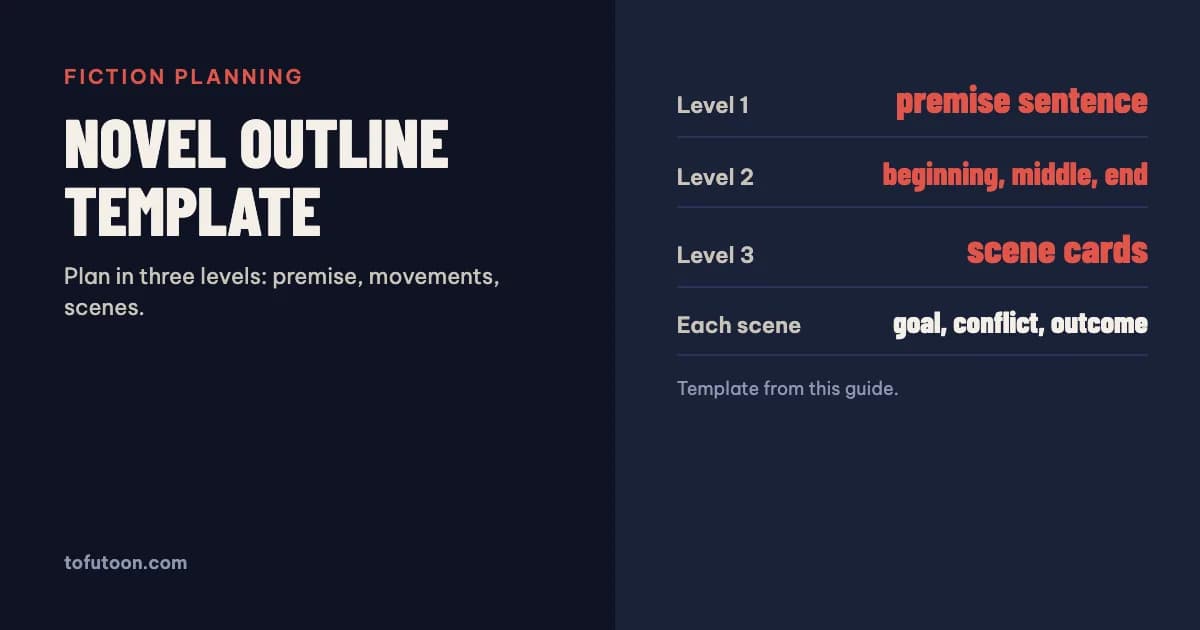
A novel outline template plans a story in three levels: a one-sentence premise, the main movements of the plot (beginning, middle and end, with the turning points between them), and a list of scenes, each with a goal, a conflict and an outcome. Scenes are then grouped into chapters. You can outline lightly or in detail; the template below works for both, and it sets the manuscript up so the chapters become a clean table of contents later.
What is a novel outline?
A novel outline is a plan of the story’s events in order, written before or alongside the draft, that shows how the plot moves from its opening situation to its ending. The oldest description of that shape is still useful. In the Poetics, Aristotle wrote that a whole plot has “a beginning, a middle, and an end”, and that a well-constructed plot must neither begin nor end at haphazard (Aristotle, Poetics, tr. S. H. Butcher, Project Gutenberg). Outlining applies that idea at three zoom levels. The premise says what the story is about. The movements say how it turns. The scene list says what happens on the page. Writers who dislike outlining often still keep the first two levels, because they protect the ending, and discover the scenes while drafting. Writers who outline fully use the scene level as their writing plan for each day.
What goes in each level of the template?
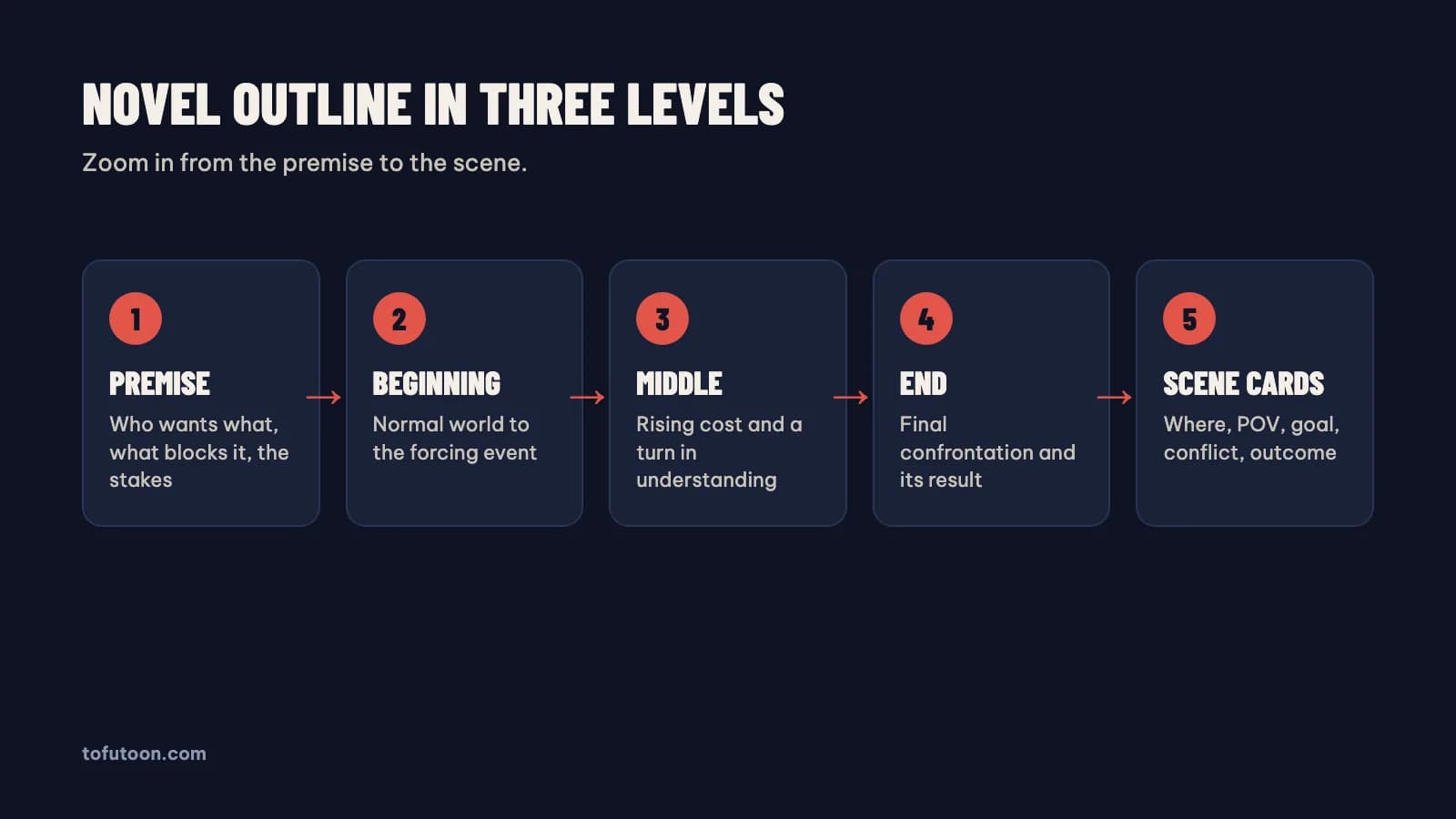
Level one, the premise: one sentence with the protagonist, what they want, what stands in the way, and what is at stake if they fail. If you cannot write it, the story is not clear yet. Level two, the movements: the beginning sets up the character’s normal world and ends with the event that forces them to act; the middle raises the cost through rising complications and a turn that changes their understanding; the end is the final confrontation and its result. Write two or three sentences for each, and name the turning points between them. Level three, the scene cards: one line for where and when, the point-of-view character, their goal in the scene, the conflict that blocks it, and the outcome, which should leave things changed, usually worse. A scene where nothing changes is a candidate for cutting or merging.
How do scenes become chapters?
Scenes are units of story; chapters are units of reading. A chapter can hold one scene or several, and a long scene can span a chapter break when you want suspense. A practical way to group them is by outcome: end a chapter where an outcome leaves a question open, and start the next one with the consequence. Mark scene breaks inside a chapter in your manuscript with a consistent symbol on its own line, so they survive into the formatted book. Keep a running list of chapter numbers and their scenes in the outline; when you move scenes, you will see at once which chapters became too long or too thin. If a prologue earns its place, list it in the outline before chapter one. Kindle Create, for example, treats a prologue as front matter and describes it as showing an event that sets the scene, usually in fiction.
How do you keep the outline useful while drafting?
Treat the outline as a living map, not a script. After each writing session, update the scene card with what actually happened, and adjust the following cards if the story changed direction. Set up the draft with styles so the outline and the manuscript stay connected: chapter titles as Heading 1 in Word, so the Navigation Pane mirrors the outline and lets you reorder chapters. That same structure pays off in formatting. Kindle Create detects chapter titles when it imports a Word file and builds the table of contents from them (KDP: Prepare Reflowable and Print Books with Kindle Create), and in a printed book every chapter starts on a new page, with chapter one on a right-hand page (KDP: Front, Body and Back Matter). Chapter titles typed in bold by hand are invisible to those tools.
FAQ
Do I have to outline every scene before I write?
No. Many writers outline the premise and the main turns, then plan scenes a few at a time. The template works at any depth; the premise and the ending are the parts most worth fixing early.
What is the difference between a novel outline and a synopsis?
An outline is a working plan for you, broken into scenes or chapters. A synopsis is a short prose summary of the whole plot, including the ending, written for agents or editors. A finished outline makes the synopsis much easier to write.
Next step: when the draft is done and you plan to submit, use Shunn manuscript format; if you self-publish, start with how to format a book in Word for KDP and the free KDP trim size guide. Keep the scene breaks consistent and they carry through: the pay-once formatter we are developing for Windows and Mac turns the chapters and scene breaks of a Word manuscript into a print PDF and an EPUB, offline. Join the waitlist to hear when it is ready.