
Autobiography Template for Word: Structure and Chapters
Your life story is easier to write from a timeline and a chapter plan. A Word template, the two structures that work, and the KDP setup.
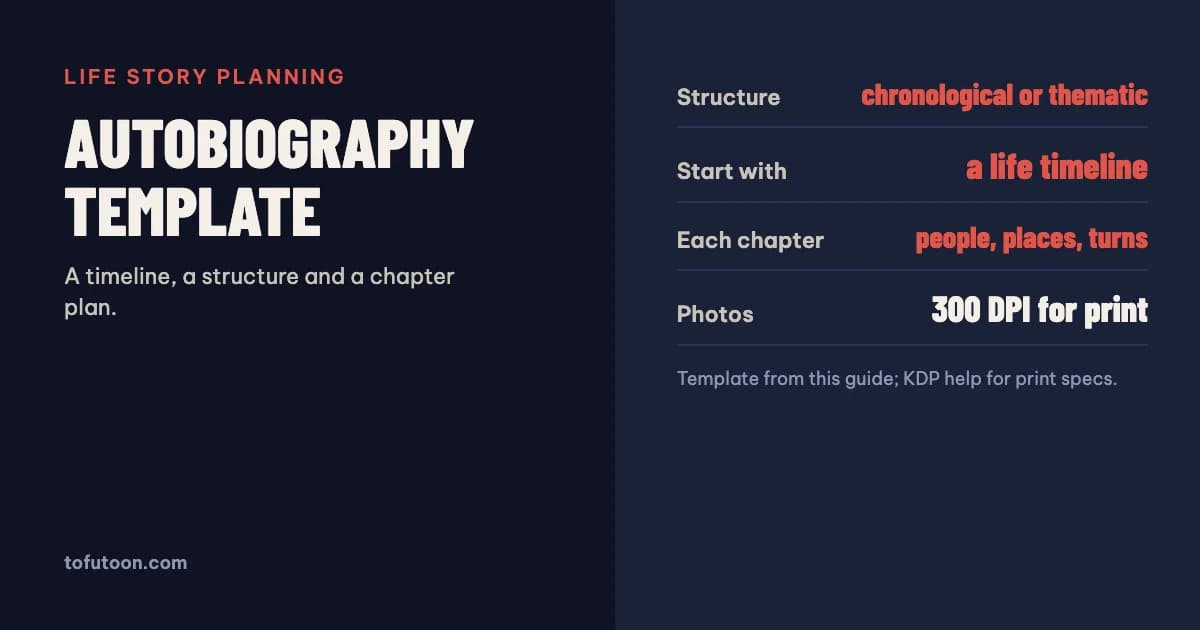
An autobiography template is a ready structure for writing your life story: a timeline of life periods, a chapter plan in either chronological or thematic order, and a standard set of front and back matter. In Word it works best as a document with heading styles for chapters, so the same file can later become a printed book or an eBook. Below are the template, the two structures, and the KDP settings to use if you publish it yourself.
What is the difference between an autobiography and a memoir?
An autobiography is the story of the author’s whole life, or most of it, usually told in time order from early years to the present. A memoir is narrower: it covers one period, theme or relationship, such as a career, an illness or a move abroad, and it can jump in time to follow that thread. Both are written in the first person and both are true stories, so the same template serves either; what changes is the scope you choose at the start. That choice matters for length and for readers. A full autobiography invites family members, colleagues and future generations to find themselves in it. A memoir invites strangers to follow one question through your life. Decide which book you are writing before you fill in the chapter plan, because it decides which memories belong in the book and which stay in your notes.
What goes in an autobiography template?
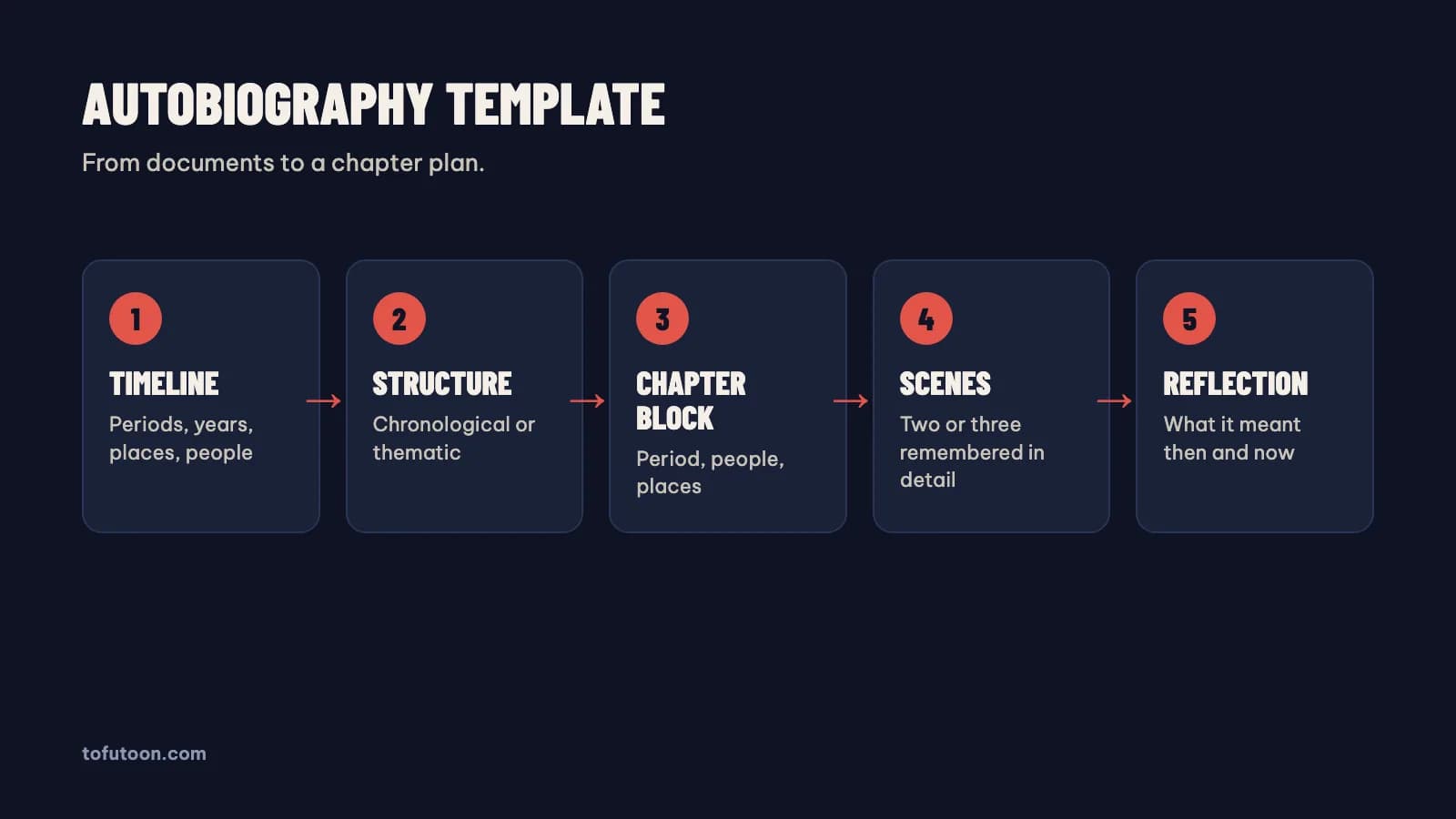
Begin with a life timeline: a simple table with rows for each period (childhood, school, first work, family, career, later years) and columns for years, places, people and events. Fill it from documents first, such as photos, letters, certificates and old calendars, because memory alone gets dates wrong. Then choose a structure. Chronological follows the timeline, one period per chapter or several chapters per period. Thematic groups chapters by subject, such as work, faith or home, and moves through time inside each chapter. For each chapter, write a block with the period or theme, the key people and places, two or three scenes you remember in detail, the turning point, and what it meant then compared with what it means now. That last field gives an autobiography its reflection; without it, the chapters read like a list of events.
How do you set the template up in Word?
Create the chapter plan with styles: each chapter title in Heading 1 and each scene or section in Heading 2, so Word’s Navigation Pane shows the whole book and lets you move chapters around. If you plan to print through KDP, you can start from Amazon’s free Word templates, which come blank with page size and margins already set, or with sample content such as a title page, contents and chapters (KDP: Paperback and Hardcover Manuscript Templates). Remove every bit of placeholder text before upload, because KDP can reject a book that still contains it. Front matter for an autobiography is usually a title page, copyright page, dedication and contents, sometimes a preface or introduction; back matter often holds acknowledgments, an author bio and a family tree or photo section. KDP lists the common order of these pages (KDP: Front, Body and Back Matter).
What about photos and real people?
Photos bring an autobiography to life, and they have technical and legal sides. For print, KDP asks for images of at least 300 DPI, so scan old prints at a high resolution rather than photographing them with a phone at an angle, and keep captions short and factual. For eBooks, images add to the file size. On the legal side, copyright in a photo usually belongs to whoever took it, not to the people in it, so check rights for any image you did not take yourself. Real people raise privacy and reputation questions: KDP’s content guidelines make authors responsible for ensuring their content does not violate copyright, privacy, publicity or other rights (KDP: Content Guidelines). Write about others fairly, check facts against documents, and when in doubt, ask permission or change identifying details. For anything serious, ask a lawyer where you live; this guide is not legal advice.
FAQ
How long should an autobiography be?
There is no fixed length. A family autobiography for relatives can be short, while a published life story is often a full-length book. Decide the scope first, chronological whole life or one theme, and let the chapter plan set the length.
Should an autobiography be written in chronological order?
Chronological order is the easiest for readers to follow and suits a whole-life story. A thematic structure works better when your life has strong separate threads. Either way, keep a timeline so dates and ages stay consistent.
Next step: when the draft is ready, read How to format a book in Word for a KDP paperback, choose a size in the free KDP trim size guide, and if you want an ISBN barcode for printing outside KDP, use the ISBN barcode generator. For a life story with chapters and photos, the pay-once book formatter we are building for Windows and Mac produces a print PDF and an EPUB from your Word file, offline. It is not released yet; join the waitlist.