
Comic narrator AI voice: one voice or one per character?
Same six bubbles, four formats, measured. A single narrator wins on long series for reasons that have little to do with how the voice sounds.
Start with one comic narrator AI voice unless your pages are short and the story lives in the dialogue. One narrator means one file and one edit, and it gives you a retelling with room for your own view of the chapter. A full cast sounds closer to an audio drama, and you pay for it with a clip per bubble. To put numbers on that, we voiced the same six bubbles from our own comic four different ways.
The same scene, four ways
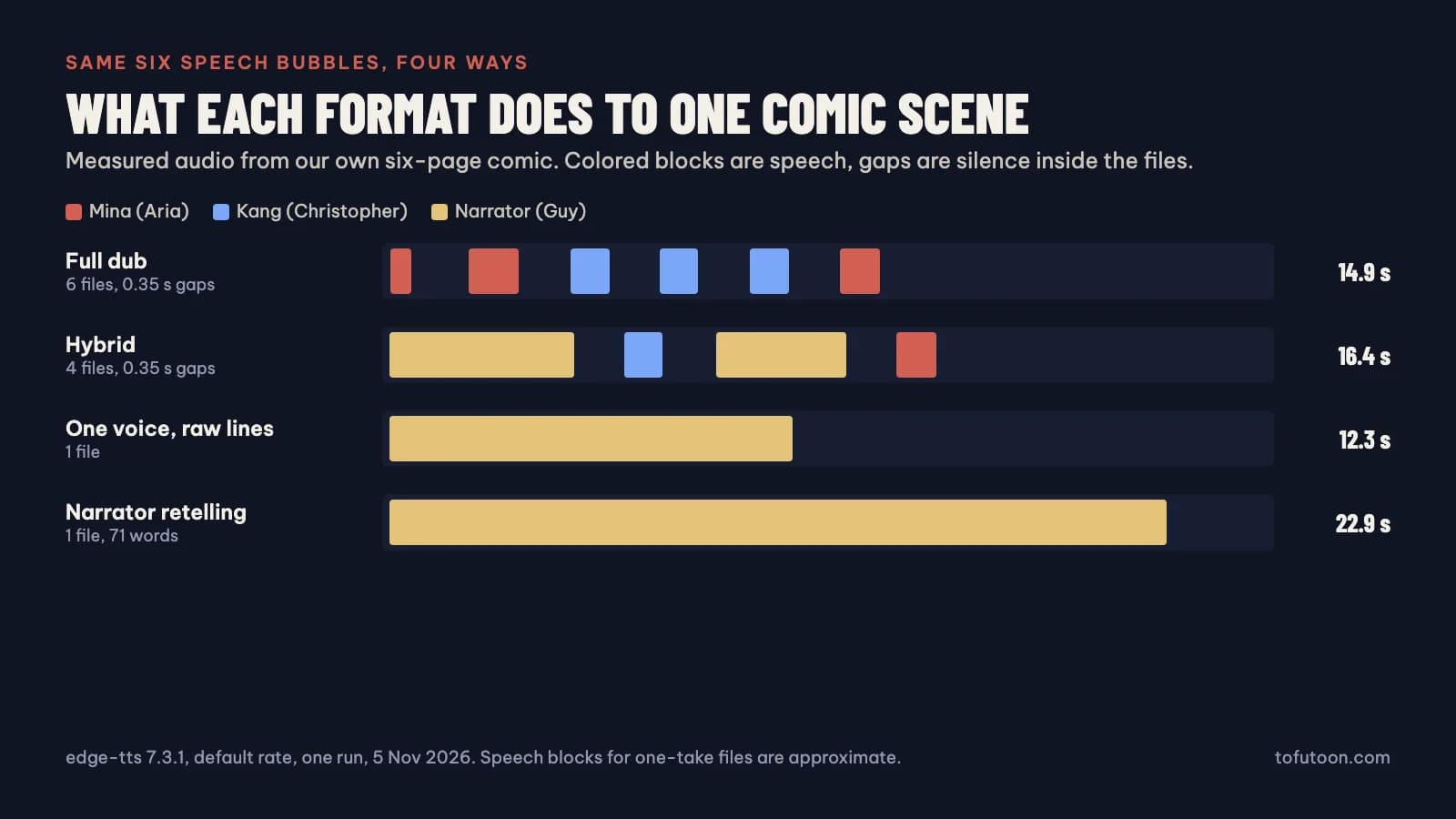
The scene is two characters and six bubbles. Mina is Aria, Kang is Christopher, the narrator is Guy. Here's what came out of one run with edge-tts 7.3.1, default speed, before any trimming:
- Full dub: 6 files, 14.9 s with 0.35 s gaps. Each bubble is its own clip on the timeline.
- Hybrid: 4 files, 16.4 s. The narrator carries the scene and two lines keep their characters: "Stay behind me!" and "Then why are you bleeding?"
- One voice, raw lines: 1 file, 12.3 s. The shortest, and the one we would never publish.
- Narrator retelling: 1 file, 22.9 s for 71 words. The longest, because it explains what the art shows and who says what.
Read the raw version on paper and you'll see the problem: "I came back for you. Then why are you bleeding?" Those are two people. In one voice nothing marks the change, so the second line reads like a man asking himself a question. A narrator fixes this with five words: "Mina asks the only question that matters." That's why raw lines in one voice is the format to avoid, even though it's the quickest.
Why one narrator usually wins on a long series
The file count decides it. A chapter with 90 bubbles means 90 clips in a full dub and one in a retelling. Multiply that by a weekly upload, and the casting sheet, naming and trimming start eating the time you wanted for the story. Generating is cheap. Each line in the scene took about a second. The work comes after.
A retelling also gives you a place to put yourself. YouTube's monetization policies say borrowed material has to be changed significantly to become your own, and a retelling with your take has more room for that than a reading of someone else's dialogue. It doesn't make a recap safe from copyright claims, and nothing we can write will, but it's a better starting point. There's a cost: someone has to write it. An AI draft helps, and your own view is the part only you can add.
When a full cast is worth the clips
We'd go full cast for short strips, comedy where the timing is the joke, and any scene that is pure argument. A two-page strip has a dozen lines, so the clip count stays friendly. It's also the right choice when you own the comic and want it to feel like a production.
For an action series on a weekly schedule, hybrid is where we'd end up, after a month of plain narration. Keep the narrator for the plot and spend character voices on the two or three lines people will remember. You add a handful of clips, and the cast sheet stays short enough to keep consistent by episode 12. Our comic dub steps walk through casting and trimming those clips.
Choosing a narrator voice with numbers, then your ears
We timed twelve Edge voices reading the same 859 words of Pride and Prejudice with edge-tts 7.3.1. Nobody rated how they sound, so this won't tell you which one you'll like. It tells you what you're getting before you listen. The speed figures are words per minute, the pitch is a rough median:
- Roger: 168 wpm, about 178 Hz. The slowest of the twelve.
- Eric: 174 wpm, about 109 Hz. Low and unhurried.
- Christopher: 176 wpm, about 113 Hz.
- Aria: 177 wpm, about 205 Hz.
- Steffan: 179 wpm, about 144 Hz.
- Jenny: 180 wpm, about 180 Hz.
- Ryan (British): 181 wpm, about 129 Hz.
- Michelle: 182 wpm, about 188 Hz.
- Guy: 188 wpm, about 154 Hz.
- Sonia (British): 189 wpm, about 200 Hz.
- Emma: 192 wpm, about 186 Hz.
- Andrew: 193 wpm, about 113 Hz. The fastest.
Two things to take from that list. Pace changes your runtime more than you'd guess: an 1,800-word script runs about 10 minutes 45 seconds on Roger and about 9 minutes 20 seconds on Andrew, before you touch the speed setting. On Aria, setting the speed to -10% gave 159 wpm and +10% gave 195. And pitch tells you who to keep apart. Andrew and Christopher both sit near 113 Hz, so don't make them rivals in the same scene.
Then audition your top two on a line with a name, a number and a question, because those show a voice's weak spots fastest. Pick the one you can stand for an hour. Keep it for the whole series. Tofu Image Text offers Edge voices, the 129 CapCut voices listed in the app (counted on 31 October 2026), offline voices, and ElevenLabs through the ElevenLabs API, which ElevenLabs bills directly. Our voice over comparison goes further on engines.
Writing lines a narrator can say
A narrator exposes a messy script faster than a cast does, because nothing else changes to hold attention. Three habits helped in our scene. Name the speaker when it changes, since the voice won't do it for you. Use a period wherever you want a beat, as "Run. Now." held a pause of almost a second while commas and ellipses held about 0.2 s. And delete every leftover tag, because "[SFX: SLASH!]" added 2.6 seconds of a voice reading a stage direction to a three-word line.
Does YouTube care that the narrator is AI?
Not on its own, as we read the rules. YouTube's disclosure page asks you to label realistic content, like making a real person appear to say something they didn't. It says you don't need to label clearly unrealistic content, or using AI to help with a script or a title, and that cloning your own voice for voice-overs doesn't need a label. A clearly synthetic voice narrating drawn characters is a different case from a voice copying a real person. Never clone someone without permission. The bigger risk for a narrated channel is sameness, and that's covered in faceless YouTube automation.
FAQ
What is the best AI voice for a comic narrator?
There isn't one we can honestly name, because taste decides it and we only measured pace and pitch. Shortlist two voices with a pace that fits your script, test them on a hard line, and stick with one for the series.
Can I give characters different voices in Tofu Image Text?
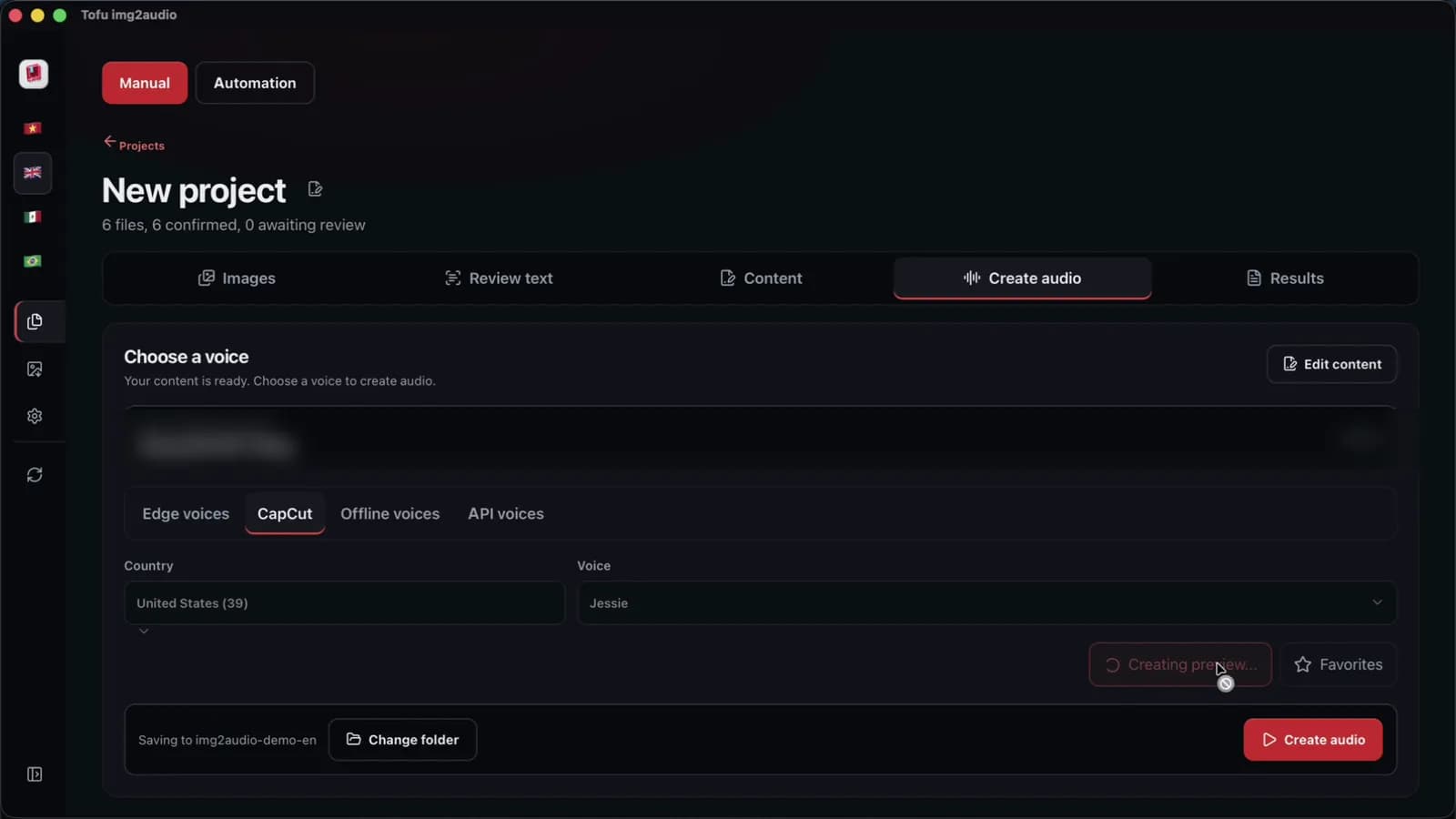
Not in one file. The app makes one audio file per chapter with one voice. For a hybrid, make the narrator track there, create the quoted lines separately and place them in your editor.
How long should a comic narration script be?
Work backwards from runtime. At 168 to 193 words per minute, the range from our voice test, a five-minute segment needs roughly 840 to 965 words. Our 71-word retelling of six bubbles ran 22.9 seconds, so plan for narration to run longer than the dialogue it replaces.
Try this next: write a short retelling of one scene and generate it alongside a version with two character lines. Compare them yourself and time how long each took you to finish. If the single track wins, Tofu Image Text will take a chapter of pages through to one audio file. If you're still deciding on a tool, start with how to choose a comic dub maker.