
YouTube story channel with AI voice over: workflow and rules
Audio story channels look simple: a voice, a still image and a long video. The rules on reused content and AI voices decide whether the channel lasts.
A YouTube story channel is a channel that publishes stories as long narrated videos, often with a still image or simple visuals over the voice. Many story channels use an AI voice instead of a recorded narrator, which makes long episodes possible for one person. The format is easy to start and easy to get wrong. Two questions decide whether the channel lasts: the right to use the story, and whether the videos add anything of your own. For example, a 30-minute episode at 150 words per minute needs about 4,500 words of script, so a novel chapter or two fits one video. The guide first covers which stories you may use, then the script and the voice. Finally, the guide covers YouTube rules from Google on reused content, AI disclosure and copyright, plus a production loop built with Tofu Voice from TofuToon.
Which stories can a YouTube story channel use?
A usable story is a story you wrote, a story you have written permission to narrate, or a work in the public domain. A novel you bought is not a license to publish an audio version; the copyright holder controls audio adaptations. First, your own writing is the safest source, and original stories also make the channel unique. Second, authors of web fiction sometimes grant narration rights on request, so ask and keep the reply. Third, public domain works are free to adapt; Project Gutenberg offers over 75,000 free eBooks, according to Project Gutenberg. Rules differ by country, so check the status of each work where you live. In practice, a channel narrating classic short stories from the public domain avoids copyright claims that a channel reading current bestsellers will face. Under the copyright strike rules from YouTube, three strikes in 90 days can end a channel.
How do you make a story channel more than reused text?
Original value is a part of each video coming from you, and the YouTube channel monetization policies reward original value. On July 15, 2025, YouTube renamed the "repetitious content" policy to "inauthentic content", which covers mass-produced or repetitive videos. A voice reading text over one static image, video after video, is exactly the pattern the policy describes. First, write your own introduction for each episode: why the story matters and what to listen for. Second, add short commentary between parts or at the end. Third, adapt the text for listening: cut stage directions, explain names and keep sentences short. Finally, vary visuals with chapter cards or simple illustrations you have the right to use. For instance, a two-minute opening in your own words and a short reflection at the end turn a reading into an episode only your channel makes.
Which AI voice suits a YouTube story channel?
The right narrator for a story channel is one calm, clear voice that listeners can bear for an hour, kept the same for every episode. A voice that sounds exciting for ten seconds can tire a listener over a long story. First, test two or three voices on one full page with dialogue, names and numbers. Second, listen at the planned speed for five minutes in a row. Finally, write the voice name and speed in a note, so episode 50 matches episode 1. Edge voices from Microsoft, such as Guy and Jenny in English or HoaiMy and NamMinh in Vietnamese, sound even over long chapters. In practice, a horror channel suits a low, slow voice, while a children’s story channel suits a warm, brighter one. Tofu Voice includes 170+ natural voices, and the Pro edition adds offline voices and a voice clone from your own recording.
How do you produce story channel episodes every week?
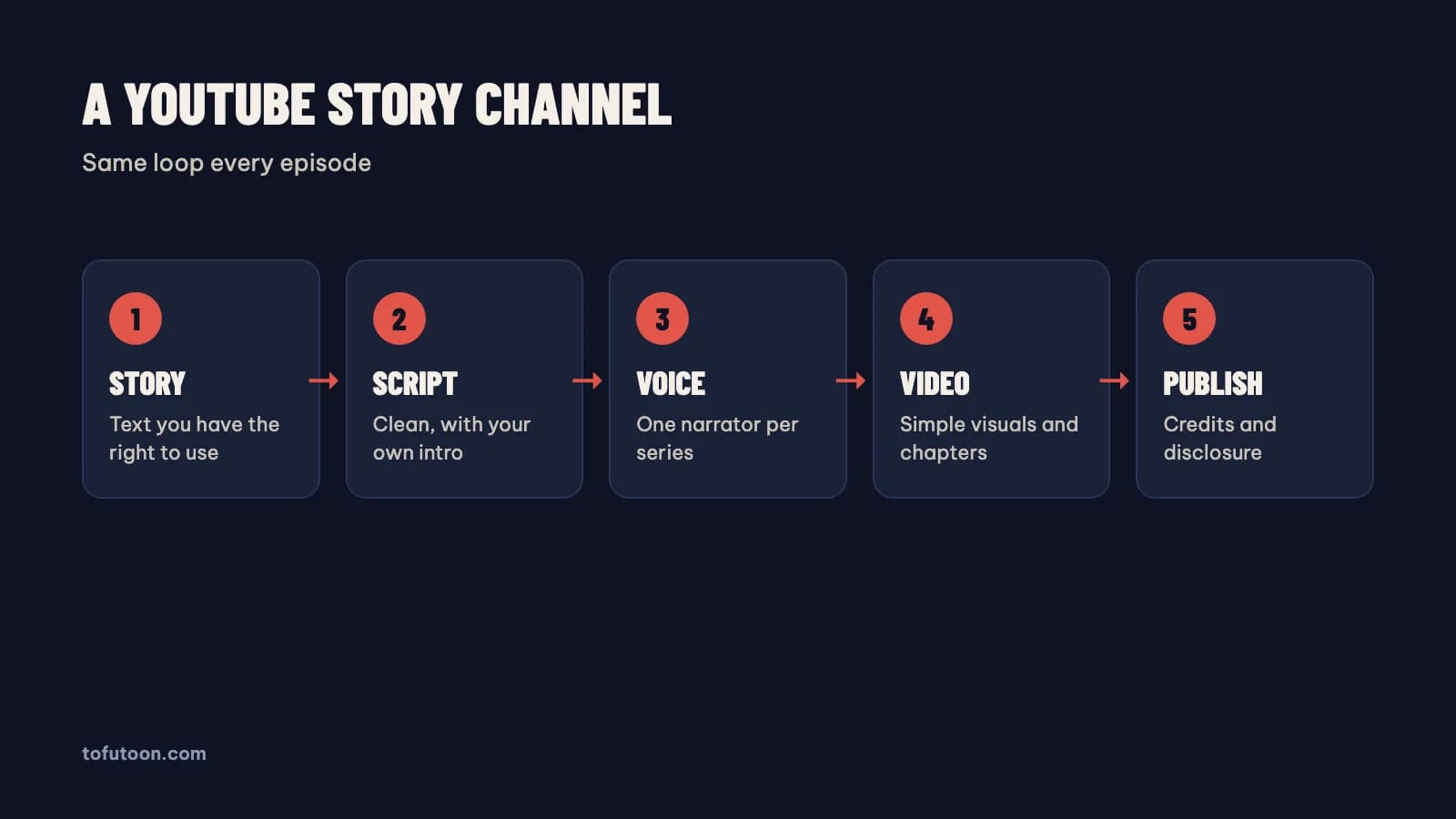
A weekly production loop is a fixed set of steps for every episode, so the channel runs on routine. Tofu Voice is a pay-once desktop app for Windows 10 or later and Apple silicon Macs (M1 or later) that turns folders of TXT files into MP3, one file per chapter. First, save the script for each part as its own TXT file, named in order. Second, convert the folder in one batch with the chosen voice; failed files can be retried without redoing the rest. Third, put the audio on a timeline in CapCut or another editor with simple visuals. Finally, add chapters in the description, since YouTube asks for at least three timestamps starting at 00:00. For example, a 40-minute episode with eight parts becomes eight MP3 files and eight chapter timestamps. Online voices, such as Edge voices from Microsoft, need internet while generating.
FAQ
Do I have to disclose an AI voice on a YouTube story channel?
AI voice disclosure on YouTube is about realistic content, not about every synthetic voice. Under the YouTube GenAI disclosure rules, introduced in March 2024, creators disclose realistic altered or synthetic content which viewers could mistake for a real person, place or event, such as a cloned voice of a real person. A clearly synthetic narrator reading a story is a different case from a voice imitating a real, identifiable person. For instance, cloning the voice of a famous actor to read a story needs both disclosure and, in practice, that person’s permission. Your own cloned voice reading your own story is far simpler, and Tofu Voice Pro can clone a voice from your own recording. Read the [YouTube GenAI disclosure rules](https://support.google.com/youtube/answer/14328491?hl=en) from Google before the first upload, since the rules can change over time.
Can a YouTube story channel with an AI voice be monetized?
A story channel with an AI voice can apply for monetization like any other channel; YouTube reviews the content, not the type of voice. According to YouTube, the Partner Program needs 1,000 subscribers plus 4,000 qualified watch hours in 12 months, or 10 million qualified Shorts views in 90 days. The channel monetization policies from Google also exclude mass-produced or repetitive videos under "inauthentic content", the name used since July 15, 2025. Say a channel has original introductions, commentary and stories it has the right to use and the channel stands on firmer ground than a channel reading copied text over one image. First, check the rights to every story. Second, plan your own commentary into every episode, from the very first upload. Read the [YouTube channel monetization policies](https://support.google.com/youtube/answer/1311392?hl=en) before applying for the program.
How long should a YouTube story channel episode be?
Episode length for a story channel depends on the story, not on a fixed rule. A short story fits 15 minutes; a novel runs as a series of parts. The math is simple: at 150 words per minute, 4,500 words give about 30 minutes, and 9,000 words give about an hour. First, split the story at natural breaks. Second, keep episode lengths similar within a series. Finally, add chapter timestamps: according to YouTube, a video needs at least three timestamps starting at 00:00, each chapter at least 10 seconds long. For example, eight chapters let a listener jump back to the last part heard. The full splitting guide is in [split an audiobook into YouTube episodes](/blog/chia-tap-truyen-audio-youtube).
Next step: pick one story you wrote or one public domain story, write a short introduction in your own words, and produce one episode with one tested voice. Upload with chapters and credits. For folders of chapter scripts, see Tofu Voice, and read Vietnamese text to speech for the voice test.